-2-797x638.jpg "Denisovans")
Denisovans
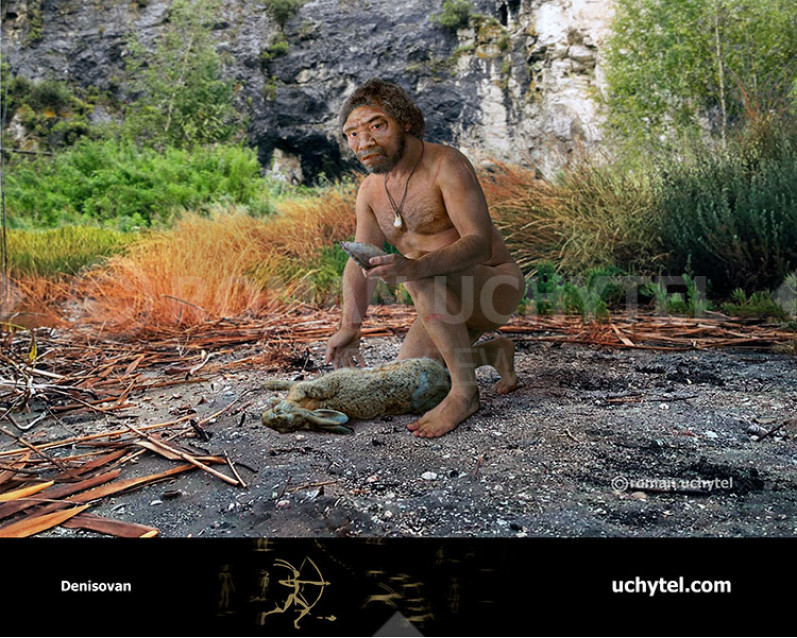
202181202181Denisovans (†Homo sp. Altai (Krause et al., 2010))
Epoch: Middle-Late Pleistocene (at least about 200,000-50,000 years ago)
Habitat: Asia, from Siberia and the Tibetan Plateau to eastern Asia
Dimensions: unknown
Diet: probably omnivorous
Denisovans entered the story of human evolution in an extraordinary way - discovered not through a complete skull or skeleton, but largely through DNA extracted from a tiny finger bone fragment found in Siberia's Denisova Cave in 2010. Since then, only a handful of highly fragmentary fossils, including teeth and jaw remains, have been confidently attributed to them. One remarkable story unfolded on the Tibetan Plateau, where an ancient human jawbone - discovered in 1980 by a Buddhist monk meditating in the sacred Baishiya Karst Cave - was later identified as a 160,000-year-old Denisovan remains. Their vast geographical range, spanning from the freezing caves of Siberia to the high-altitude plateaus of Tibet, suggests that Denisovans may have differed considerably in appearance across Asia.
Their world was deeply interconnected with other ancient humans, and they interbred with both Neanderthals and Homo sapiens. The most extraordinary evidence of this is «Denny», a teenage girl who lived around 90,000 years ago and was proven to be a first-generation hybrid with a Neanderthal mother and a Denisovan father. While Denisovans eventually disappeared as a distinct population, they never truly vanished. Today, their genetic legacy is strongest in present-day Papuan and other Oceanian populations. Furthermore, a Denisovan-derived version of the EPAS1 gene actively helps modern Tibetans cope with low oxygen levels at extreme altitudes, proving that this elusive ancient population continues to live on within millions of people today.

-2-70x56.jpg "2")
Denisovans (†Homo sp. Altai (Krause et al., 2010))
Epoch: Middle-Late Pleistocene (at least about 200,000-50,000 years ago)
Habitat: Asia, from Siberia and the Tibetan Plateau to eastern Asia
Dimensions: unknown
Diet: probably omnivorous
Denisovans entered the story of human evolution in an extraordinary way - discovered not through a complete skull or skeleton, but largely through DNA extracted from a tiny finger bone fragment found in Siberia's Denisova Cave in 2010. Since then, only a handful of highly fragmentary fossils, including teeth and jaw remains, have been confidently attributed to them. One remarkable story unfolded on the Tibetan Plateau, where an ancient human jawbone - discovered in 1980 by a Buddhist monk meditating in the sacred Baishiya Karst Cave - was later identified as a 160,000-year-old Denisovan remains. Their vast geographical range, spanning from the freezing caves of Siberia to the high-altitude plateaus of Tibet, suggests that Denisovans may have differed considerably in appearance across Asia.
Their world was deeply interconnected with other ancient humans, and they interbred with both Neanderthals and Homo sapiens. The most extraordinary evidence of this is «Denny», a teenage girl who lived around 90,000 years ago and was proven to be a first-generation hybrid with a Neanderthal mother and a Denisovan father. While Denisovans eventually disappeared as a distinct population, they never truly vanished. Today, their genetic legacy is strongest in present-day Papuan and other Oceanian populations. Furthermore, a Denisovan-derived version of the EPAS1 gene actively helps modern Tibetans cope with low oxygen levels at extreme altitudes, proving that this elusive ancient population continues to live on within millions of people today.