-797x638.jpg "Homo erectus")
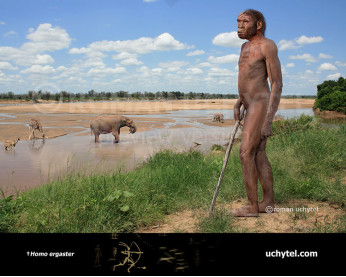
Homo erectus
202188202188Homo erectus (†Homo erectus (Dubois, 1893))
Order: Primates
Family: Hominidae
Dimensions: height - 140-170 сm, weight - 40-50 kg
Temporal range: Pleistocene ( 2-0.1 million years ago)
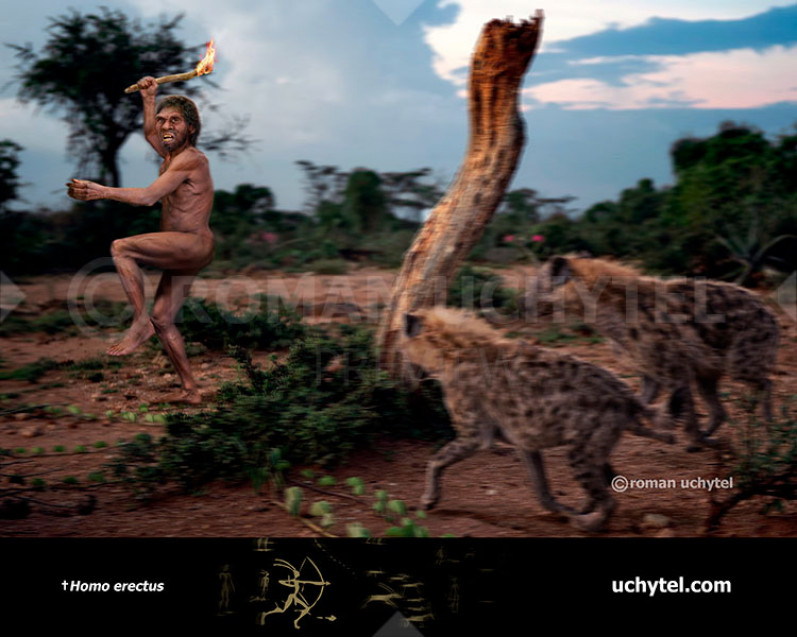
Homo erectus was one of the first ancient humans to spread far beyond Africa and one of the longest-surviving human species ever known. Appearing nearly 1.9 million years ago, these early humans became the first members of our family known to spread widely beyond Africa, eventually reaching the Caucasus, China and the Indonesian island of Java. They adapted to an extraordinary range of environments, from tropical forests to cool northern grasslands, and survived as a species until roughly 110,000 years ago. Homo erectus made increasingly sophisticated stone tools, hunted and scavenged animals, and probably used fire, although exactly when and how regularly they mastered it is still debated. Hearths would have offered more than cooked food and warmth: fire could keep dangerous predators away and may have created some of the earliest gathering places where our ancestors spent time together after dark. At different points in its immense history, Homo erectus shared the world with other human relatives, and different populations probably contributed to later branches of the human family.
The story of Homo erectus began with one of paleoanthropology’s most adventurous
searches. Convinced that the evolutionary «missing link» could be found in
Asia, Dutch physician Eugène Dubois travelled to Indonesia, where in 1891 he
discovered a skullcap on Java and named its owner Pithecanthropus erectus, the «upright ape-man». The fossil became
famous as Java Man, while later discoveries in China created another cultural
icon, Peking Man. For generations, Peking Man was popularly portrayed in China
as an ancient ancestor and even became a symbol of national origins, inspiring
museums, art and theatrical works such as Primitive
Love of Peking Man. Homo erectus
has since appeared in documentaries, paleoart and fiction, although popular
«caveman» portrayals often bear little resemblance to the real species. Perhaps
its greatest legend is the old image of a primitive creature standing at the
beginning of humanity. In reality, Homo
erectus was something far more impressive: an adaptable explorer that
crossed continents and survived for nearly two million years, while our own
species has existed for only a fraction of that time.

-70x56.jpg "2")
Homo erectus (†Homo erectus (Dubois, 1893))
Order: Primates
Family: Hominidae
Dimensions: height - 140-170 сm, weight - 40-50 kg
Temporal range: Pleistocene ( 2-0.1 million years ago)
Homo erectus was one of the first ancient humans to spread far beyond Africa and one of the longest-surviving human species ever known. Appearing nearly 1.9 million years ago, these early humans became the first members of our family known to spread widely beyond Africa, eventually reaching the Caucasus, China and the Indonesian island of Java. They adapted to an extraordinary range of environments, from tropical forests to cool northern grasslands, and survived as a species until roughly 110,000 years ago. Homo erectus made increasingly sophisticated stone tools, hunted and scavenged animals, and probably used fire, although exactly when and how regularly they mastered it is still debated. Hearths would have offered more than cooked food and warmth: fire could keep dangerous predators away and may have created some of the earliest gathering places where our ancestors spent time together after dark. At different points in its immense history, Homo erectus shared the world with other human relatives, and different populations probably contributed to later branches of the human family.
The story of Homo erectus began with one of paleoanthropology’s most adventurous
searches. Convinced that the evolutionary «missing link» could be found in
Asia, Dutch physician Eugène Dubois travelled to Indonesia, where in 1891 he
discovered a skullcap on Java and named its owner Pithecanthropus erectus, the «upright ape-man». The fossil became
famous as Java Man, while later discoveries in China created another cultural
icon, Peking Man. For generations, Peking Man was popularly portrayed in China
as an ancient ancestor and even became a symbol of national origins, inspiring
museums, art and theatrical works such as Primitive
Love of Peking Man. Homo erectus
has since appeared in documentaries, paleoart and fiction, although popular
«caveman» portrayals often bear little resemblance to the real species. Perhaps
its greatest legend is the old image of a primitive creature standing at the
beginning of humanity. In reality, Homo
erectus was something far more impressive: an adaptable explorer that
crossed continents and survived for nearly two million years, while our own
species has existed for only a fraction of that time.