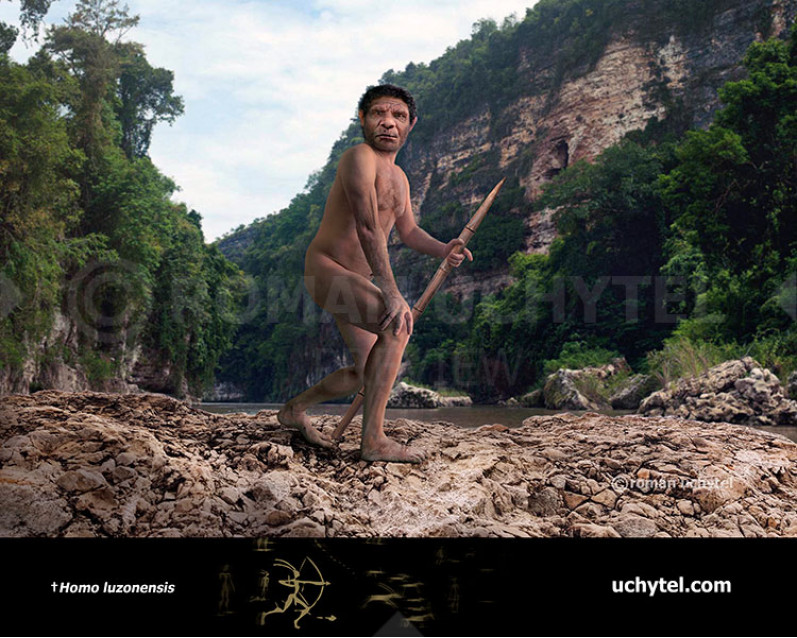
-797x638.jpg "Callao Man (Homo luzonensis)")
Callao Man (Homo luzonensis)
202189202189Callao Man (†Homo luzonensis (Détroit et al., 2019))
Order: Primates
Family: Hominidae
Dimensions: height - 120-150 сm, weight - 30-50 kg
Temporal range: Late Pleistocene (Luzon, the Philippines, 0.134–0.049 Ma )
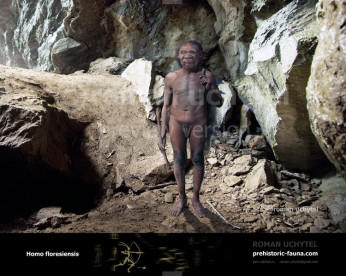
Homo luzonensis, also known as Callao Man, is an extinct, possibly pygmy, species of archaic human from the Late Pleistocene of Luzon, the Philippines. Their remains, teeth and phalanges, are known only from Callao Cave in the northern part of the island dating to before 50,000 years ago. The inhabitants of the cave dragged in mainly Philippine deer carcasses, and used tools for butchering.
They were initially identified as belonging to modern humans in 2010, but in 2019, after the discovery of more specimens, they were placed into a new species based on the presence of a wide range of traits similar to modern humans as well as to Australopithecus and early Homo. In 2023, a study found that the fossilized remains were 134,000 ± 14,000 years old, much older than previously thought.
Their ancestors, who may have been Asian H. erectus or some other even earlier Homo, would have needed to have made a sea crossing of several miles at minimum to reach the island. Hominin presence on Luzon dates to as early as 771,000 to 631,000 years ago.

-70x56.jpg "2")
Callao Man (†Homo luzonensis (Détroit et al., 2019))
Order: Primates
Family: Hominidae
Dimensions: height - 120-150 сm, weight - 30-50 kg
Temporal range: Late Pleistocene (Luzon, the Philippines, 0.134–0.049 Ma )
Homo luzonensis, also known as Callao Man, is an extinct, possibly pygmy, species of archaic human from the Late Pleistocene of Luzon, the Philippines. Their remains, teeth and phalanges, are known only from Callao Cave in the northern part of the island dating to before 50,000 years ago. The inhabitants of the cave dragged in mainly Philippine deer carcasses, and used tools for butchering.
They were initially identified as belonging to modern humans in 2010, but in 2019, after the discovery of more specimens, they were placed into a new species based on the presence of a wide range of traits similar to modern humans as well as to Australopithecus and early Homo. In 2023, a study found that the fossilized remains were 134,000 ± 14,000 years old, much older than previously thought.
Their ancestors, who may have been Asian H. erectus or some other even earlier Homo, would have needed to have made a sea crossing of several miles at minimum to reach the island. Hominin presence on Luzon dates to as early as 771,000 to 631,000 years ago.