Oreopithecus
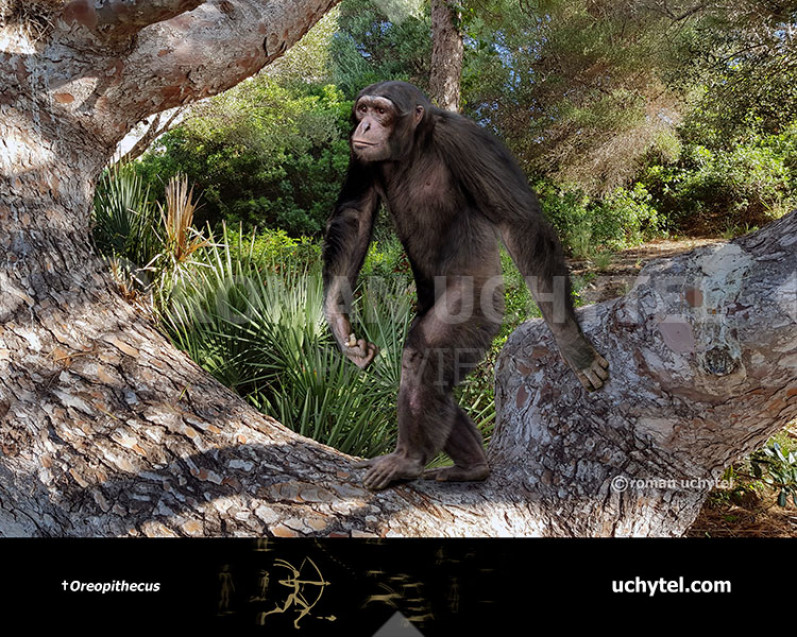
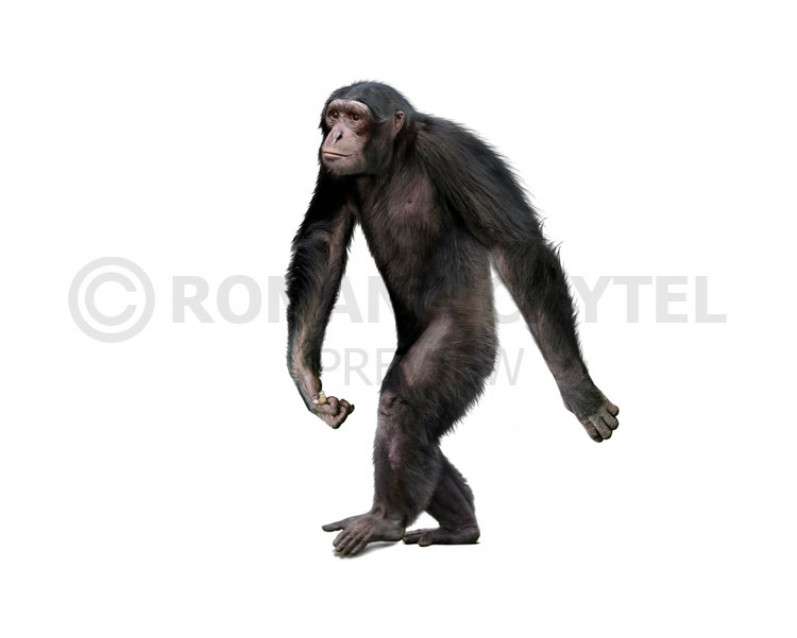
202203202203Oreopithecus (†Oreopithecus (Gervais, 1872))
Order: Primates
Superfamily: Hominoidea
Temporal range: Miocene epoch of Europe (9–7 million years ago)
Size: 105 cm in height, 30-35 kg of weight.
Typical representative: Oreopithecus bambolii
Oreopithecus is an extinct genus of ape from the Miocene epoch whose fossils have been found in today's Tuscany and Sardinia in Italy. It existed 9–7 million years ago in that region when it formed an isolated island in a chain of islands stretching from central Europe to northern Africa in what was becoming the Mediterranean Sea.
Oreopithecus was one of many European immigrants that settled this area. This new evidence confirmed that Oreopithecus was bipedal but also revealed that its peculiar form of bipedalism was much different from that of Australopithecus. The hallux formed a 100° angle with the other toes, which enabled the foot to act as a tripod in erect posture, but prevented Oreopithecus from developing a fast bipedal stride. When a land bridge broke the isolation of the Tusco-Sardinian area 6.5 million years ago, large predators such as Machairodus and Metailurus were present among the new generation of European immigrants and Oreopithecus faced quick extinction together with other endemic genera. Because of the ecological versatility of O. bambolii, environmental change has not been considered a sufficient explanation for its demise; predation and competition appear to have been the most likely extinction drivers of the species.
Known as the "enigmatic hominoid", Oreopithecus can dramatically rewrite the palaeontological map depending on whether it is a descendant of the European ape Dryopithecus or an African anthropoid. Some have suggested the unique locomotory behavior of Oreopithecus requires a revision of the current consensus on the timing of bipedality in human developmental history, but there is limited agreement on this point among paleontologists.
Simons (1960) considered Oreopithecus closely related to the early Oligocene Apidium, a small arboreal anthropoid that lived nearly 34 million years ago in Egypt. Oreopithecus shows strong links to modern apes in its postcranium and, in this respect, it is the most modern Miocene ape below the neck, with closest similarities to the postcranial elements of Dryopithecus, but its dentition is adapted to a leafy diet and a close link is uncertain. Others claim it to be either the sister taxon to Cercopithecoidea or an even direct human ancestor, but it is usually placed in its own subfamily within Hominidae. It could instead be added to the same subfamily as Dryopithecus, perhaps as a distinct tribe (Oreopithecini). A cladistic analysis of Nyanzapithecus alesi recovers Oreopithecus as a member of the proconsulid subfamily Nyanzapithecinae. A 2023 phylogenetic analysis suggested found a close relationship with gibbons, though the author suggested that this was likely due to having a similar climbing lifestyle and retained plesiomorphies, rather than a real close relationship, but suggested that it was unlikely that Oreopithecus was a member of Hominidae.


Oreopithecus (†Oreopithecus (Gervais, 1872))
Order: Primates
Superfamily: Hominoidea
Temporal range: Miocene epoch of Europe (9–7 million years ago)
Size: 105 cm in height, 30-35 kg of weight.
Typical representative: Oreopithecus bambolii
Oreopithecus is an extinct genus of ape from the Miocene epoch whose fossils have been found in today's Tuscany and Sardinia in Italy. It existed 9–7 million years ago in that region when it formed an isolated island in a chain of islands stretching from central Europe to northern Africa in what was becoming the Mediterranean Sea.
Oreopithecus was one of many European immigrants that settled this area. This new evidence confirmed that Oreopithecus was bipedal but also revealed that its peculiar form of bipedalism was much different from that of Australopithecus. The hallux formed a 100° angle with the other toes, which enabled the foot to act as a tripod in erect posture, but prevented Oreopithecus from developing a fast bipedal stride. When a land bridge broke the isolation of the Tusco-Sardinian area 6.5 million years ago, large predators such as Machairodus and Metailurus were present among the new generation of European immigrants and Oreopithecus faced quick extinction together with other endemic genera. Because of the ecological versatility of O. bambolii, environmental change has not been considered a sufficient explanation for its demise; predation and competition appear to have been the most likely extinction drivers of the species.
Known as the "enigmatic hominoid", Oreopithecus can dramatically rewrite the palaeontological map depending on whether it is a descendant of the European ape Dryopithecus or an African anthropoid. Some have suggested the unique locomotory behavior of Oreopithecus requires a revision of the current consensus on the timing of bipedality in human developmental history, but there is limited agreement on this point among paleontologists.
Simons (1960) considered Oreopithecus closely related to the early Oligocene Apidium, a small arboreal anthropoid that lived nearly 34 million years ago in Egypt. Oreopithecus shows strong links to modern apes in its postcranium and, in this respect, it is the most modern Miocene ape below the neck, with closest similarities to the postcranial elements of Dryopithecus, but its dentition is adapted to a leafy diet and a close link is uncertain. Others claim it to be either the sister taxon to Cercopithecoidea or an even direct human ancestor, but it is usually placed in its own subfamily within Hominidae. It could instead be added to the same subfamily as Dryopithecus, perhaps as a distinct tribe (Oreopithecini). A cladistic analysis of Nyanzapithecus alesi recovers Oreopithecus as a member of the proconsulid subfamily Nyanzapithecinae. A 2023 phylogenetic analysis suggested found a close relationship with gibbons, though the author suggested that this was likely due to having a similar climbing lifestyle and retained plesiomorphies, rather than a real close relationship, but suggested that it was unlikely that Oreopithecus was a member of Hominidae.