-797x638.jpg "Ardipithecus ramidus")
-797x638.jpg "Ardipithecus ramidus")
1-797x638.jpg "Ardipithecus ramidus")
Ardipithecus ramidus
111111Ardipithecus (Ardipithecus White et al., 1995)
Order: Primates
Family: Hominidae
Dimensions: height - 150 сm, weight - 65 kg
Temporal range: Early Pliocene of East Africa (5,8 - 4,4 million years ago)
A typical representative: Ardipithecus ramidus Owen, 1846
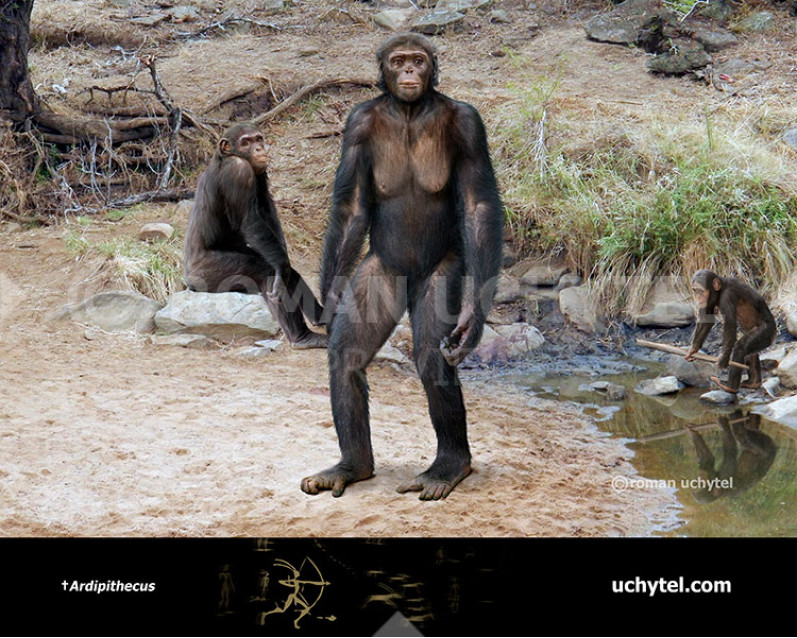
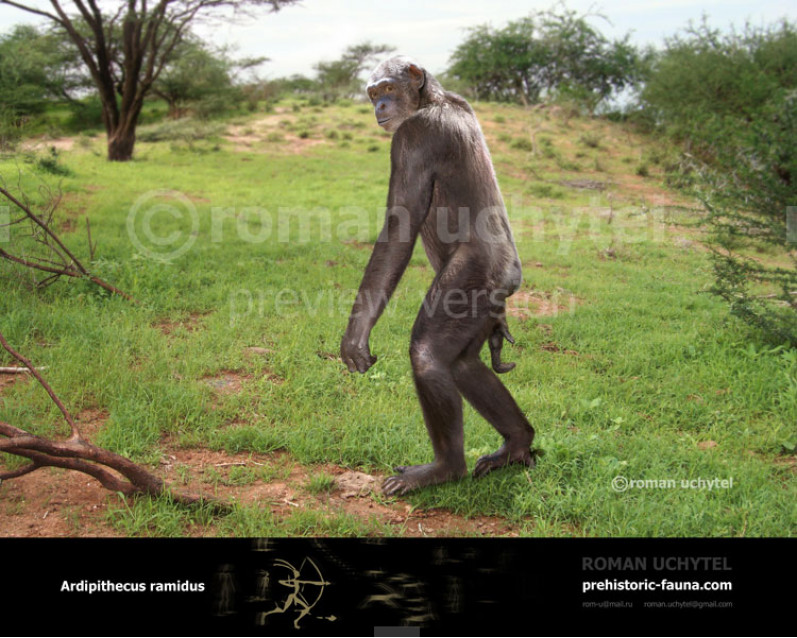
Ardipithecus ramidus gives us a remarkable glimpse of what our distant ancestors were like before the human body became fully adapted to walking on two legs. Living in Ethiopia about 4.4 million years ago, this early hominin combined features that seem almost contradictory today. Its pelvis shows adaptations for upright walking, yet its grasping big toe and powerful feet allowed it to climb through trees. Unlike modern chimpanzees and gorillas, Ardipithecus was probably not a habitual knuckle-walker. Its small brain was roughly comparable in size to that of a chimpanzee, but its reduced canine teeth were already different from the large, projecting canines of modern African apes. Even its habitat was unexpected: Ardipithecus lived mainly in woodland rather than open grassland, challenging the once-popular idea that our ancestors first stood upright because they moved onto the African savanna.
The most famous individual is Ardi, a remarkably complete 4.4-million-year-old female skeleton discovered at Aramis in Ethiopia in 1994. Her extremely fragile bones required years of painstaking reconstruction before scientists introduced her to the world in detail in 2009. Her name carries an appropriate symbolism: in the local Afar language, ardi means «ground» or «floor», while ramid means «root», reflecting the species’ position close to the early roots of the human family.
Ardipithecus ramidus lived long before Australopithecus afarensis, including the famous Lucy, and may
represent an earlier stage of the evolutionary story that eventually led to
Australopithecus and later humans, although its exact relationship to our
direct ancestry remains debated. Ardi has since become an icon of human-origins
documentaries, books, museum exhibitions and paleoart. Unlike Lucy, however,
she has rarely entered fictional popular culture, and there are no authentic
ancient legends specifically about her species. Perhaps the most significant
myth Ardi helped overturn was a scientific one: she showed that our earliest
ancestors did not simply look and move like modern chimpanzees, but had already
begun to follow the distinct evolutionary path that would eventually lead to humans.

-70x56.jpg "2")

-70x56.jpg "4")
1-70x56.jpg "5")
Ardipithecus (Ardipithecus White et al., 1995)
Order: Primates
Family: Hominidae
Dimensions: height - 150 сm, weight - 65 kg
Temporal range: Early Pliocene of East Africa (5,8 - 4,4 million years ago)
A typical representative: Ardipithecus ramidus Owen, 1846
Ardipithecus ramidus gives us a remarkable glimpse of what our distant ancestors were like before the human body became fully adapted to walking on two legs. Living in Ethiopia about 4.4 million years ago, this early hominin combined features that seem almost contradictory today. Its pelvis shows adaptations for upright walking, yet its grasping big toe and powerful feet allowed it to climb through trees. Unlike modern chimpanzees and gorillas, Ardipithecus was probably not a habitual knuckle-walker. Its small brain was roughly comparable in size to that of a chimpanzee, but its reduced canine teeth were already different from the large, projecting canines of modern African apes. Even its habitat was unexpected: Ardipithecus lived mainly in woodland rather than open grassland, challenging the once-popular idea that our ancestors first stood upright because they moved onto the African savanna.
The most famous individual is Ardi, a remarkably complete 4.4-million-year-old female skeleton discovered at Aramis in Ethiopia in 1994. Her extremely fragile bones required years of painstaking reconstruction before scientists introduced her to the world in detail in 2009. Her name carries an appropriate symbolism: in the local Afar language, ardi means «ground» or «floor», while ramid means «root», reflecting the species’ position close to the early roots of the human family.
Ardipithecus ramidus lived long before Australopithecus afarensis, including the famous Lucy, and may
represent an earlier stage of the evolutionary story that eventually led to
Australopithecus and later humans, although its exact relationship to our
direct ancestry remains debated. Ardi has since become an icon of human-origins
documentaries, books, museum exhibitions and paleoart. Unlike Lucy, however,
she has rarely entered fictional popular culture, and there are no authentic
ancient legends specifically about her species. Perhaps the most significant
myth Ardi helped overturn was a scientific one: she showed that our earliest
ancestors did not simply look and move like modern chimpanzees, but had already
begun to follow the distinct evolutionary path that would eventually lead to humans.
-346x277.jpg "Gigantopithecus blacki")