-797x638.jpg "Proconsul")
Proconsul
202145202145Proconsul (†Proconsul africanus (Hopwood, 1933b))
Order: Primates
Suborder: Haplorhini
Family: †Proconsulidae
Temporal range: during Miocene of the Africa (23–14 Ma )
Dimensions: weight - 18 kg
Proconsul africanus was a fruit eater and its brain was larger than that of a monkey, although probably not as large as that of a modern ape. It was an animal which lived from about 23 to 14 million years ago during the Miocene epoch.
The 18-million-year-old fossil species has been considered a possible ancestor of both great and lesser apes, and of humans. The paleontologist Louis Leakey, who was one of the foremost fossil-hunters of the 20th century and a champion of evolution, said: An especially important creature was Proconsul africanus. This, many authorities once concluded, gave us an indication of the common stock for apes and men. We have good forelimb bones for it, and in 1948 on Rusinga Island Mary [Leakey] discovered a skull, the first nearly complete specimen ever found. Its canine teeth suggest an ape's, while its forehead reminds us of our own. It seems to me, however, to be neither an ancestral ape, nor yet an ancestor of man, but a side branch with characteristics of both stocks..."
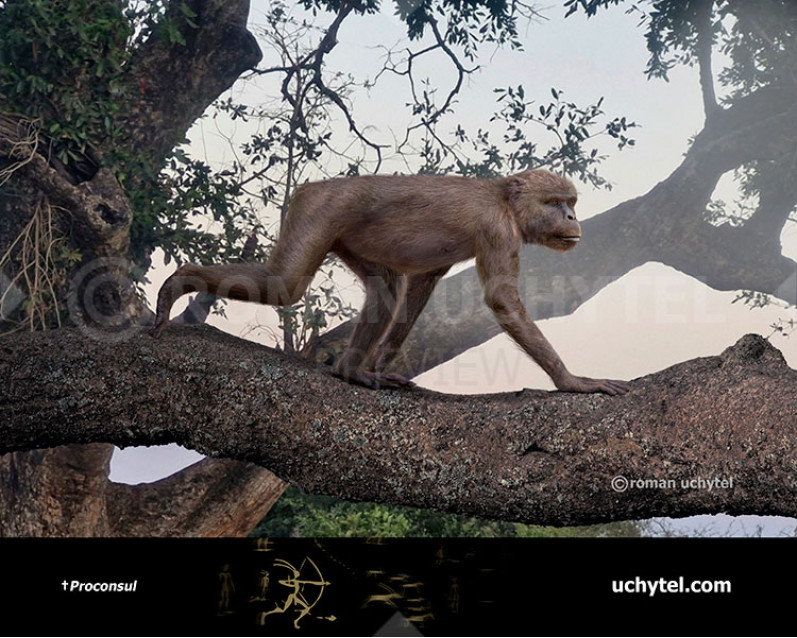
Leakey changed his mind a few times about the exact classification of Proconsul, as did most other palaeontologists. Opinion currently favors a position between the monkeys and the apes. Proconsul has a cranial capacity of 167 cm3 and an encephalization quotient of 1.5. Based on the cranium, this species had an external brain surface much like that of gibbons and cercopithecoid monkeys. Overall the skeleton of this species can be described as being robust. This species had an average body mass of around 18 kg . Based on postcranial pieces, it was likely an arboreal quadruped.

-70x56.jpg "2")
Proconsul (†Proconsul africanus (Hopwood, 1933b))
Order: Primates
Suborder: Haplorhini
Family: †Proconsulidae
Temporal range: during Miocene of the Africa (23–14 Ma )
Dimensions: weight - 18 kg
Proconsul africanus was a fruit eater and its brain was larger than that of a monkey, although probably not as large as that of a modern ape. It was an animal which lived from about 23 to 14 million years ago during the Miocene epoch.
The 18-million-year-old fossil species has been considered a possible ancestor of both great and lesser apes, and of humans. The paleontologist Louis Leakey, who was one of the foremost fossil-hunters of the 20th century and a champion of evolution, said: An especially important creature was Proconsul africanus. This, many authorities once concluded, gave us an indication of the common stock for apes and men. We have good forelimb bones for it, and in 1948 on Rusinga Island Mary [Leakey] discovered a skull, the first nearly complete specimen ever found. Its canine teeth suggest an ape's, while its forehead reminds us of our own. It seems to me, however, to be neither an ancestral ape, nor yet an ancestor of man, but a side branch with characteristics of both stocks..."
Leakey changed his mind a few times about the exact classification of Proconsul, as did most other palaeontologists. Opinion currently favors a position between the monkeys and the apes. Proconsul has a cranial capacity of 167 cm3 and an encephalization quotient of 1.5. Based on the cranium, this species had an external brain surface much like that of gibbons and cercopithecoid monkeys. Overall the skeleton of this species can be described as being robust. This species had an average body mass of around 18 kg . Based on postcranial pieces, it was likely an arboreal quadruped.