Eomaia
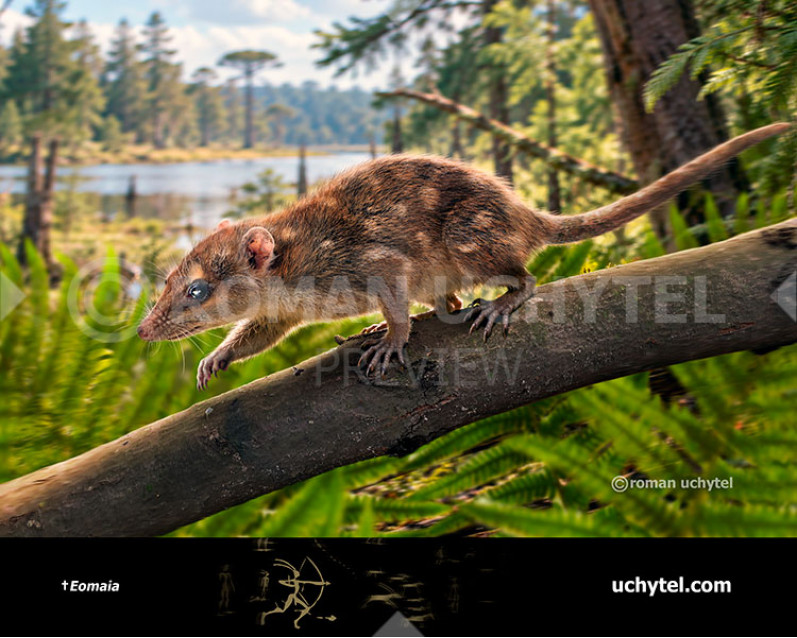
2029020290Eomaia (†Eomaia (Ji et al., 2002))
Clade: Tribosphenida
Temporal range: during Early Cretaceous in Asia ( China, ~125 Ma)
Dimensions: lenght ~10 сm, weight - 20–25 grams
A typical representative: †Eomaia scansoria
Eomaia is a genus of extinct fossil mammals containing the single species Eomaia scansoria, discovered in rocks that were found in the Yixian Formation, Liaoning Province, China, and dated to the Lower Cretaceous about 125 million years ago. It was possessed several features in common with placental mammals that distinguish them from metatherians, the group that includes modern marsupials. The single fossil specimen of this species is exceptionally well-preserved for a 125-million-year-old specimen. Although the fossil's skull is squashed flat, its teeth, tiny foot bones, cartilages and even its fur are visible.
However, this is not the earliest clear evidence of hair in the mammalian lineage, as fossils of Volaticotherium, and the docodont Castorocauda, discovered in rocks dated to about 164 million years ago, also have traces of fur.
Eomaia, like other early mammals and living marsupials, had a narrow pelvic outlet suggesting small undeveloped neonates requiring extensive nurturing. Epipubic bones extend forwards from the pelvis; these are not found in any placental, but are found in all other mammals, including non-placental eutherians, marsupials, monotremes and other Mesozoic mammals as well as in the cynodont therapsids that are closest to mammals. Their function is to stiffen the body during locomotion. This stiffening would be harmful in pregnant placentals, whose abdomens need to expand.
Eomaia (†Eomaia (Ji et al., 2002))
Clade: Tribosphenida
Temporal range: during Early Cretaceous in Asia ( China, ~125 Ma)
Dimensions: lenght ~10 сm, weight - 20–25 grams
A typical representative: †Eomaia scansoria
Eomaia is a genus of extinct fossil mammals containing the single species Eomaia scansoria, discovered in rocks that were found in the Yixian Formation, Liaoning Province, China, and dated to the Lower Cretaceous about 125 million years ago. It was possessed several features in common with placental mammals that distinguish them from metatherians, the group that includes modern marsupials. The single fossil specimen of this species is exceptionally well-preserved for a 125-million-year-old specimen. Although the fossil's skull is squashed flat, its teeth, tiny foot bones, cartilages and even its fur are visible.
However, this is not the earliest clear evidence of hair in the mammalian lineage, as fossils of Volaticotherium, and the docodont Castorocauda, discovered in rocks dated to about 164 million years ago, also have traces of fur.
Eomaia, like other early mammals and living marsupials, had a narrow pelvic outlet suggesting small undeveloped neonates requiring extensive nurturing. Epipubic bones extend forwards from the pelvis; these are not found in any placental, but are found in all other mammals, including non-placental eutherians, marsupials, monotremes and other Mesozoic mammals as well as in the cynodont therapsids that are closest to mammals. Their function is to stiffen the body during locomotion. This stiffening would be harmful in pregnant placentals, whose abdomens need to expand.