Steropodon
2029120291Steropodon (†Steropodon (Archer, Flannery, Ritchie, & Molnar, 1985)
Order: Monotremata
Family: †Steropodontidae
Dimensions: length - 40–50 cm, weight ~5 kg
Temporal range: Cretaceous period (Australia, 100.2–96.6 Ma )
Typical representative: †Steropodon galmani
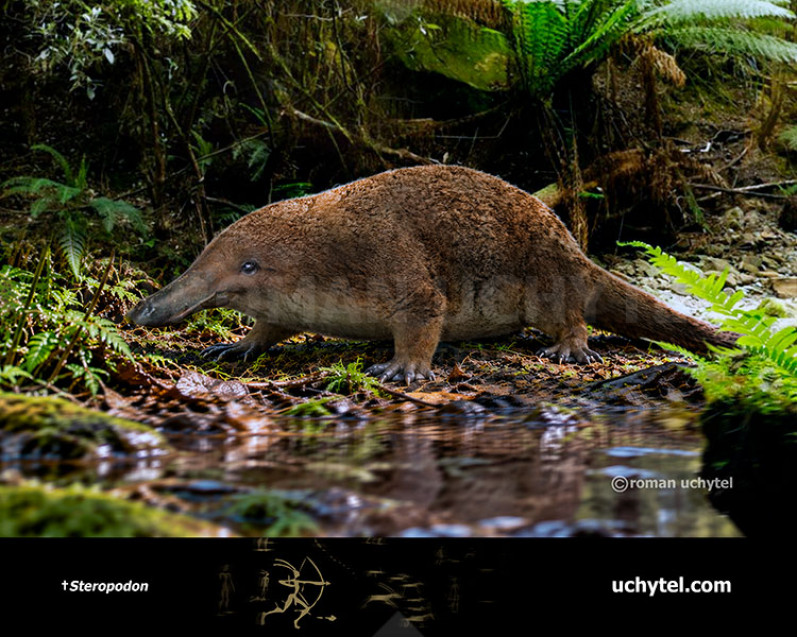
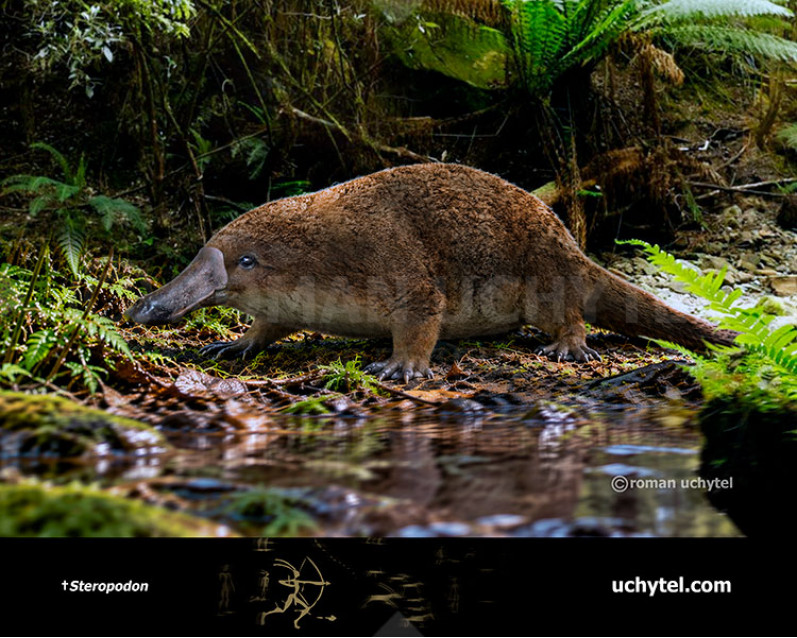
Steropodon is a genus of prehistoric platypus-like monotreme, or egg-laying mammal. It contains a single species, Steropodon galmani, that lived about 100.2–96.6 million years ago during the Cretaceous period, from early to middle Cenomanian. It is one of the oldest monotremes discovered, and is one of the oldest Australian mammal discoveries. Several other monotremes are known from the Griman Creek Formation, including Dharragarra, Kollikodon, Opalios, Parvopalus, and Stirtodon.
Steropodon is known only from a single opalised jaw with three molars, discovered at the Griman Creek Formation, Lightning Ridge, New South Wales, Australia, by brothers David and Alan Galman. It was a large mammal for the Mesozoic, being 40–50 centimetres long. The lower molars are 5–7 millimetres in length, with a width of 3–4 millimetres. A length of 1–2 centimetres is more typical for Mesozoic mammals.
Woodburne (2003, p. 212) reports that the holotype is a right mandible named AM F66763. The preserved molars are m1–m3. Examination of the jaw fragment revealed a mandibular canal, which has been proposed to indicate the presence of a bill, similar to those of the extinct species Obdurodon dicksoni and the modern platypus Ornithorhynchus anatinus.
The dentition of Steropodon is somewhat similar to that of therians—the placentals and the marsupials—specifically the presence of the tribosphenic molar tooth which was thought to be exclusive to therians since the Cretaceous. This, along with the tribosphenic molar discoveries of monotreme-relatives Ausktribosphenos and Ambondro mahabo of which the latter evolved in the Jurassic, led to the conclusion that the molar evolved independently in the two lineages. This inspired the creation of the subclasses Australosphenida—the monotremes and extinct relatives—and Tribosphenida—placentals and marsupials. However, given this classification is based only on jaw and lower-tooth remains, insufficient evidence may exist to definitively make this conclusion.


Steropodon (†Steropodon (Archer, Flannery, Ritchie, & Molnar, 1985)
Order: Monotremata
Family: †Steropodontidae
Dimensions: length - 40–50 cm, weight ~5 kg
Temporal range: Cretaceous period (Australia, 100.2–96.6 Ma )
Typical representative: †Steropodon galmani
Steropodon is a genus of prehistoric platypus-like monotreme, or egg-laying mammal. It contains a single species, Steropodon galmani, that lived about 100.2–96.6 million years ago during the Cretaceous period, from early to middle Cenomanian. It is one of the oldest monotremes discovered, and is one of the oldest Australian mammal discoveries. Several other monotremes are known from the Griman Creek Formation, including Dharragarra, Kollikodon, Opalios, Parvopalus, and Stirtodon.
Steropodon is known only from a single opalised jaw with three molars, discovered at the Griman Creek Formation, Lightning Ridge, New South Wales, Australia, by brothers David and Alan Galman. It was a large mammal for the Mesozoic, being 40–50 centimetres long. The lower molars are 5–7 millimetres in length, with a width of 3–4 millimetres. A length of 1–2 centimetres is more typical for Mesozoic mammals.
Woodburne (2003, p. 212) reports that the holotype is a right mandible named AM F66763. The preserved molars are m1–m3. Examination of the jaw fragment revealed a mandibular canal, which has been proposed to indicate the presence of a bill, similar to those of the extinct species Obdurodon dicksoni and the modern platypus Ornithorhynchus anatinus.
The dentition of Steropodon is somewhat similar to that of therians—the placentals and the marsupials—specifically the presence of the tribosphenic molar tooth which was thought to be exclusive to therians since the Cretaceous. This, along with the tribosphenic molar discoveries of monotreme-relatives Ausktribosphenos and Ambondro mahabo of which the latter evolved in the Jurassic, led to the conclusion that the molar evolved independently in the two lineages. This inspired the creation of the subclasses Australosphenida—the monotremes and extinct relatives—and Tribosphenida—placentals and marsupials. However, given this classification is based only on jaw and lower-tooth remains, insufficient evidence may exist to definitively make this conclusion.