Nimravides
143143Nimravides (†Nimravides Kitts 1958)
Machairodus catacopsis,Nimravides catocopis, Nimravides galiani, Nimravides thinobates, Nimravides catocopis lahayishupup
Order: Carnivora
Family: Felidae
Subfamily: †Machairodontinae
Tribe: †Homotherini
Temporal range: Late Miocene in North America (11 to 6.5 Ma)
Dimensions: 1,8-2,9 m in length, 90-140 cm in height, 100-250 kg of weight (Nimravides catocopis lahayishupup up 430 kg)
Nimravides is a genus of extinct saber-toothed cats that was endemic in North America during the Late Miocene, from 11 to 6.5 Ma. Despite its scientific name, Nimravides does not belong to the Nimravidae, but is a true cat belonging to the family Felidae.
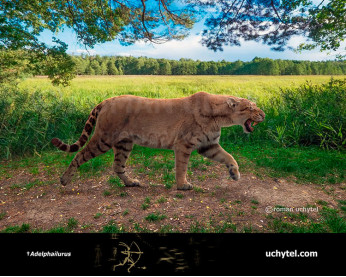
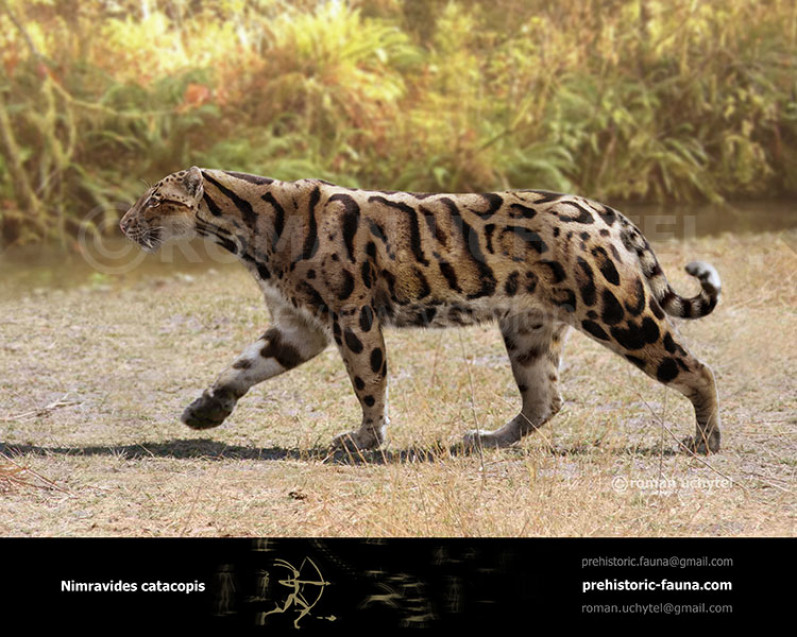
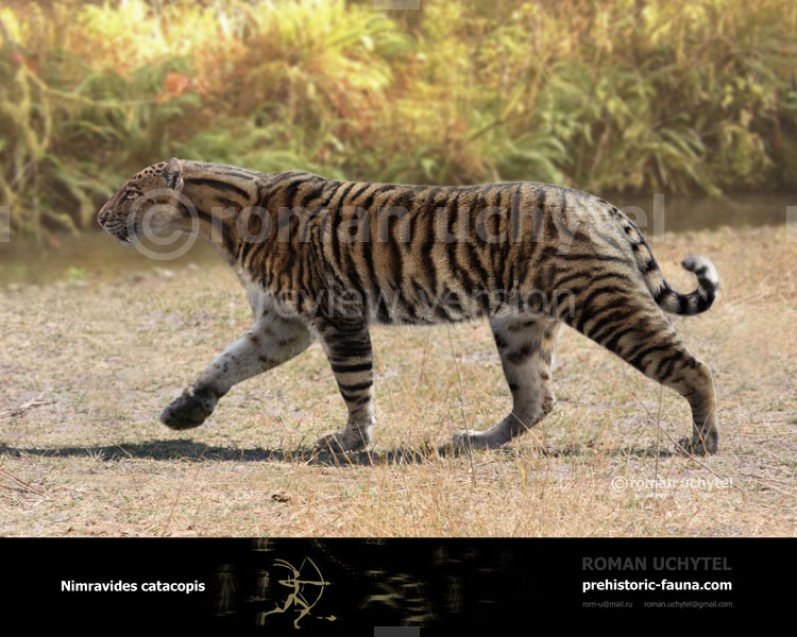
N. catocopis was obe of the largest species, with adults measuring 100 cm (1.0 m) at the shoulder and was similar in size to a large tiger. It was also possessed of long, powerful legs and a long back. The estimated that the subspecies averaged 180 kg. N. catocopis was found in Hemphillian rocks such as Chalk Hills Formation, Rattlesnake Formation, McKay Formation, and Ogallala Formation. It coexisted with herbivores such as the aceratheriinae rhino Teleoceras fossiger, "shovel tusker" amebelodontidae Amebelodon, extinct horse Pliohippus spectans, and extinct lamini Hemiauchenia vera. Other carnivorans present in the formation was the agriotheriini bear Indarctos oregonensis and extinct fox Vulpes stenognathus. Some of these herbivores, such as Teleoceras and Hemiauchenia, may have been preyed upon by Nimravides.
The subspecies known as Nimravides catocopis lahayishupup (Formerly known as Machairodus lahayishupup), grew to even larger sizes. On average, the species could’ve weighed 272 kilograms, with the largest males weighing 427 kilograms, this makes it a contender for one of the largest Felids on the planet. A 2021 paper estimated that N. c. lahayishupup could’ve hunted prey between 413 to 1,386 kilograms, with the largest possible prey weighing 1,600 kilograms, suggesting it could’ve hunted animals as large as Teleoceras.
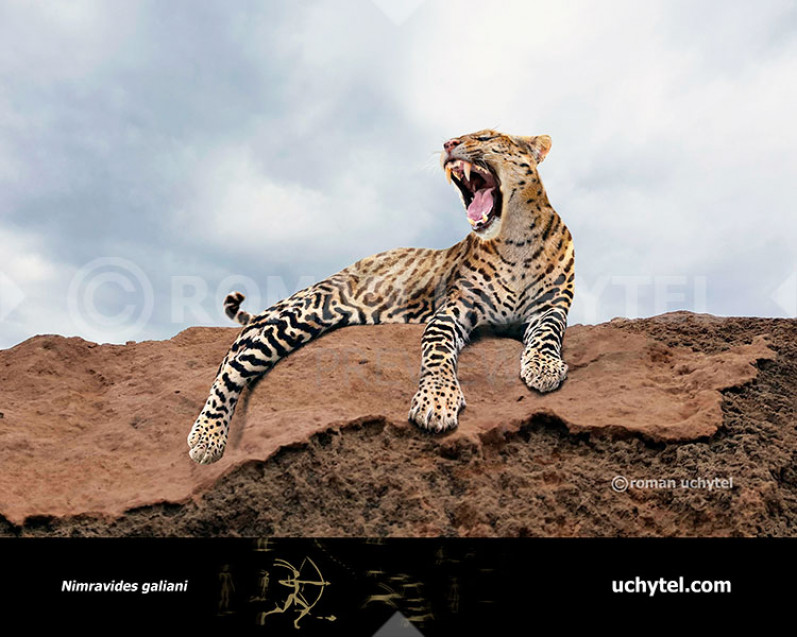
Nimravides galiani is estimated to weigh 120 kg on average, according to Meachen 2012. Jiangzuo et al. 2022 suggested it didn't overlap with N. catocopis in size. Compared to N. catocopis, it had a much smaller sexual dimorphism due to the smaller infraspecific variation in size. Many of its postcranial features resembles that of jaguars. N. galiani was found in the Love Bone Beds deposits, which had a mixture of grassland, riverine forest, and marshes, in which it would have shared territory with herbivorous animals like the amphibious rhinoceros Teleoceras, the protoceratid Synthetoceras, the camel Aepycamelus, horses like Neohipparion and Nannippus, and coexisting with barbourfelini Barbourofelis loveorum and borophaginae canids such as Epicyon and Borophagus. B. loveorum and N. galiani likely niche partitioned and competition would've been minimal due to different prey and habitat preferences. The robust forelimbs of Barbourofelis suggests it preferred forested environments, while Nimravides preferred more open habitats, such as open grasslands. The larger sizes of the Nimravides' metacarpals, suggests it would've preyed upon larger animals compared to Barbourofelis.
N. thinobates, in a 2012 study, was estimated to weigh 115 kg on average. However, Jiangzuo et al. 2022 suggested it was actually similar in size to M. aphantistus, which averaged around 153 kg.
Nimravides became extinct as part of a climate change induced faunal turnover event during the Hemphillian stage.


Nimravides (†Nimravides Kitts 1958)
Machairodus catacopsis,Nimravides catocopis, Nimravides galiani, Nimravides thinobates, Nimravides catocopis lahayishupup
Order: Carnivora
Family: Felidae
Subfamily: †Machairodontinae
Tribe: †Homotherini
Temporal range: Late Miocene in North America (11 to 6.5 Ma)
Dimensions: 1,8-2,9 m in length, 90-140 cm in height, 100-250 kg of weight (Nimravides catocopis lahayishupup up 430 kg)
Nimravides is a genus of extinct saber-toothed cats that was endemic in North America during the Late Miocene, from 11 to 6.5 Ma. Despite its scientific name, Nimravides does not belong to the Nimravidae, but is a true cat belonging to the family Felidae.
N. catocopis was obe of the largest species, with adults measuring 100 cm (1.0 m) at the shoulder and was similar in size to a large tiger. It was also possessed of long, powerful legs and a long back. The estimated that the subspecies averaged 180 kg. N. catocopis was found in Hemphillian rocks such as Chalk Hills Formation, Rattlesnake Formation, McKay Formation, and Ogallala Formation. It coexisted with herbivores such as the aceratheriinae rhino Teleoceras fossiger, "shovel tusker" amebelodontidae Amebelodon, extinct horse Pliohippus spectans, and extinct lamini Hemiauchenia vera. Other carnivorans present in the formation was the agriotheriini bear Indarctos oregonensis and extinct fox Vulpes stenognathus. Some of these herbivores, such as Teleoceras and Hemiauchenia, may have been preyed upon by Nimravides.
The subspecies known as Nimravides catocopis lahayishupup (Formerly known as Machairodus lahayishupup), grew to even larger sizes. On average, the species could’ve weighed 272 kilograms, with the largest males weighing 427 kilograms, this makes it a contender for one of the largest Felids on the planet. A 2021 paper estimated that N. c. lahayishupup could’ve hunted prey between 413 to 1,386 kilograms, with the largest possible prey weighing 1,600 kilograms, suggesting it could’ve hunted animals as large as Teleoceras.
Nimravides galiani is estimated to weigh 120 kg on average, according to Meachen 2012. Jiangzuo et al. 2022 suggested it didn't overlap with N. catocopis in size. Compared to N. catocopis, it had a much smaller sexual dimorphism due to the smaller infraspecific variation in size. Many of its postcranial features resembles that of jaguars. N. galiani was found in the Love Bone Beds deposits, which had a mixture of grassland, riverine forest, and marshes, in which it would have shared territory with herbivorous animals like the amphibious rhinoceros Teleoceras, the protoceratid Synthetoceras, the camel Aepycamelus, horses like Neohipparion and Nannippus, and coexisting with barbourfelini Barbourofelis loveorum and borophaginae canids such as Epicyon and Borophagus. B. loveorum and N. galiani likely niche partitioned and competition would've been minimal due to different prey and habitat preferences. The robust forelimbs of Barbourofelis suggests it preferred forested environments, while Nimravides preferred more open habitats, such as open grasslands. The larger sizes of the Nimravides' metacarpals, suggests it would've preyed upon larger animals compared to Barbourofelis.
N. thinobates, in a 2012 study, was estimated to weigh 115 kg on average. However, Jiangzuo et al. 2022 suggested it was actually similar in size to M. aphantistus, which averaged around 153 kg.
Nimravides became extinct as part of a climate change induced faunal turnover event during the Hemphillian stage.
-lahayishupup-346x277.jpg "Machairodus lahayishupup (Nimravides catacopsis lahayishupup)")