-797x638.jpg "Yoshi")
-797x638.jpg "Yoshi")
Yoshi
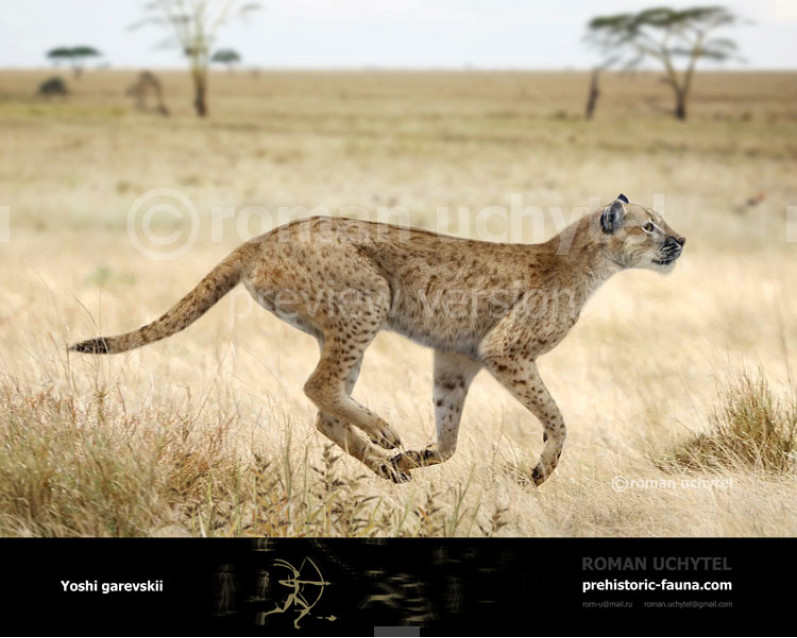
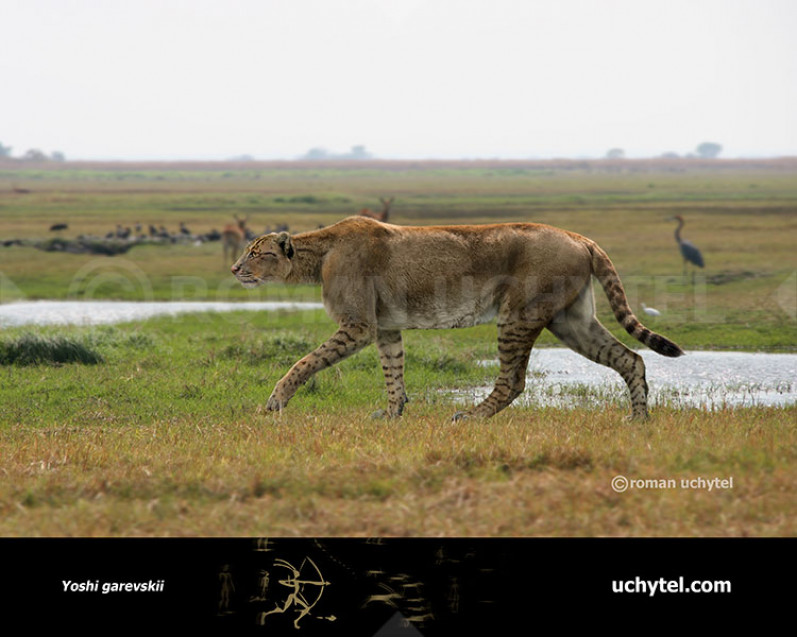
227227Yoshi (Yoshi garevskii Spassov & Geraads, 2015)
Order: Carnivore
Family: Felidae
Subfamily: Machairodontinae
Tribe: Metailurini
Size: 1,5 m in length, 70 cm in height, 30-40 kg of weight.
Time period: late Miocene of Europe
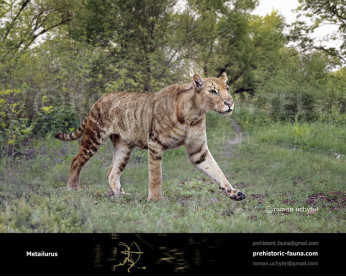
Yoshi is an extinct genus of machairodontine sabertooth cat in the tribe Metailurini. Its remains were first discovered in Pikermi, Greece, and were assigned by Reinhold Friedrich Hensel to Machairodus (under the new species M. parvulus). In 1938, Miklós Kretzoi assigned it to a new genus, Pikermia. Subsequently, it was realised that the Greek taxon was closely related to another from China, then called Parapseudailurus minor, and both were synonymised. In 2014, a new genus, Yoshi, was erected to encompass the two, resurrecting Y. minor as a valid species. As M. parvulus was a nomen dubium, a new species, Yoshi garevskii, was designated as the type. In the intervening years, three more species have been assigned to the genus: Y. faie, Y. obscura, and Y. yongdengenesis.
In some regards, such as the shape of its skull, Yoshi was convergent with cheetahs, and it was originally suggested that it may have been more cursorial (adapted for fast running) than other metailurines. However, the anatomy of its postcranial skeleton, such as the fact that its hind limbs were longer than its forelimbs, suggest that, while probably somewhat cursorial, it was not to the same extent as cheetahs. Yoshi instead had several adaptations for leaping, like many modern cats. It appears to have frequented open habitats more often than contemporary machairodonts.


-70x56.jpg "3")
-70x56.jpg "4")
Yoshi (Yoshi garevskii Spassov & Geraads, 2015)
Order: Carnivore
Family: Felidae
Subfamily: Machairodontinae
Tribe: Metailurini
Size: 1,5 m in length, 70 cm in height, 30-40 kg of weight.
Time period: late Miocene of Europe
Yoshi is an extinct genus of machairodontine sabertooth cat in the tribe Metailurini. Its remains were first discovered in Pikermi, Greece, and were assigned by Reinhold Friedrich Hensel to Machairodus (under the new species M. parvulus). In 1938, Miklós Kretzoi assigned it to a new genus, Pikermia. Subsequently, it was realised that the Greek taxon was closely related to another from China, then called Parapseudailurus minor, and both were synonymised. In 2014, a new genus, Yoshi, was erected to encompass the two, resurrecting Y. minor as a valid species. As M. parvulus was a nomen dubium, a new species, Yoshi garevskii, was designated as the type. In the intervening years, three more species have been assigned to the genus: Y. faie, Y. obscura, and Y. yongdengenesis.
In some regards, such as the shape of its skull, Yoshi was convergent with cheetahs, and it was originally suggested that it may have been more cursorial (adapted for fast running) than other metailurines. However, the anatomy of its postcranial skeleton, such as the fact that its hind limbs were longer than its forelimbs, suggest that, while probably somewhat cursorial, it was not to the same extent as cheetahs. Yoshi instead had several adaptations for leaping, like many modern cats. It appears to have frequented open habitats more often than contemporary machairodonts.