-797x638.jpg "Palaeoloxodon turkmenicus")
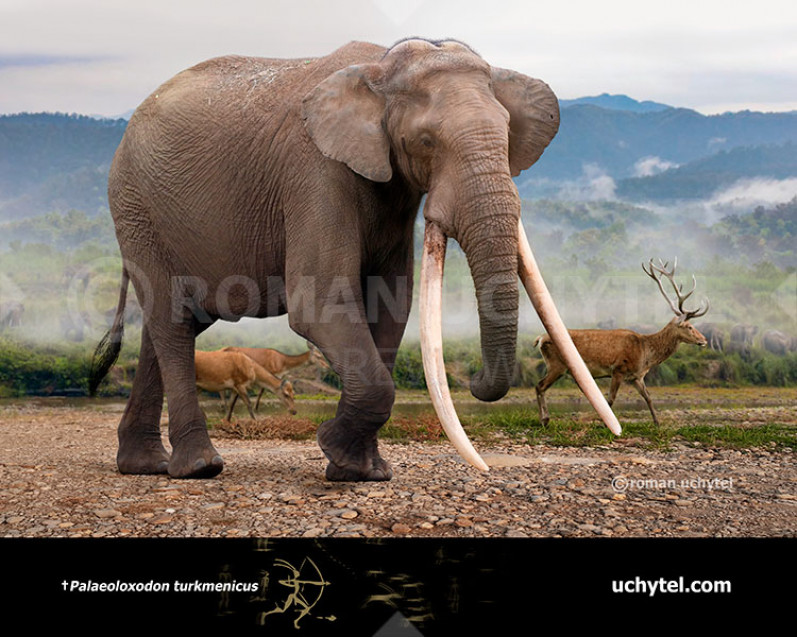
Palaeoloxodon turkmenicus
202158202158Palaeoloxodon turkmenicus (†Palaeoloxodon turkmenicus (Dubrovo, 1955))
Order: Proboscidea
Family: Elephantidae
Temporal range: during the Middle Pleistocene epoch (Central Asia and South Asia)
Dimensions: lheight - 4 m, weight - 10000 kg
Palaeoloxodon turkmenicus is an extinct species of elephant belonging to the genus Palaeoloxodon, known from the Middle Pleistocene of Central Asia and South Asia. The species was described in 1955 based on a partial adult skull, as well as an associated atlas vertebra and partial femur, found in Khuday-Dag near Krasnovodsk in what is now western Turkmenistan in Central Asia, dating to the early Middle Pleistocene. In 2024, a skull of a mature bull, around 45-55 years of age was attributed to the species from India, Jammu and Kashmir, Galandhar near Pampore in the Kashmir Valley located in the northwest of the India (probably also of Middle Pleistocene age), with this study affirming the validity of P. turkmenicus as a distinct species of Palaeoloxodon. Other remains from the site probably attributable to the specimen include the mandibles, the altas, a partial scapula, some fragmentary thoracic vertebrae, ribs and limb bone fragments, with the fragmentary remains of several other elephants (including a juvenile) also known from the site. The 2024 study proposed that Palaeoloxodon turkmenicus may represent the ancestor of other Eurasian Palaeoloxodon species, but noted that given the current paucity of skull remains of early Middle Pleistocene Palaeoloxodon that this hypothesis was tentative.
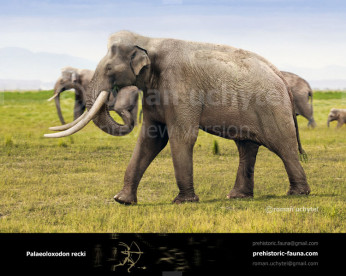
The species had a large body size, comparable to that of other mainland Eurasian Palaeoloxodon species. In contrast to most other Eurasian species of Palaeoloxodon (such as the European Palaeoloxodon antiquus and the South Asian Palaeoloxodon namadicus) the parietal-occipital crest in the forehead region of the skull is only weakly developed, similar to the African-West Asian Palaeoloxodon recki.

-70x56.jpg "2")
Palaeoloxodon turkmenicus (†Palaeoloxodon turkmenicus (Dubrovo, 1955))
Order: Proboscidea
Family: Elephantidae
Temporal range: during the Middle Pleistocene epoch (Central Asia and South Asia)
Dimensions: lheight - 4 m, weight - 10000 kg
Palaeoloxodon turkmenicus is an extinct species of elephant belonging to the genus Palaeoloxodon, known from the Middle Pleistocene of Central Asia and South Asia. The species was described in 1955 based on a partial adult skull, as well as an associated atlas vertebra and partial femur, found in Khuday-Dag near Krasnovodsk in what is now western Turkmenistan in Central Asia, dating to the early Middle Pleistocene. In 2024, a skull of a mature bull, around 45-55 years of age was attributed to the species from India, Jammu and Kashmir, Galandhar near Pampore in the Kashmir Valley located in the northwest of the India (probably also of Middle Pleistocene age), with this study affirming the validity of P. turkmenicus as a distinct species of Palaeoloxodon. Other remains from the site probably attributable to the specimen include the mandibles, the altas, a partial scapula, some fragmentary thoracic vertebrae, ribs and limb bone fragments, with the fragmentary remains of several other elephants (including a juvenile) also known from the site. The 2024 study proposed that Palaeoloxodon turkmenicus may represent the ancestor of other Eurasian Palaeoloxodon species, but noted that given the current paucity of skull remains of early Middle Pleistocene Palaeoloxodon that this hypothesis was tentative.
The species had a large body size, comparable to that of other mainland Eurasian Palaeoloxodon species. In contrast to most other Eurasian species of Palaeoloxodon (such as the European Palaeoloxodon antiquus and the South Asian Palaeoloxodon namadicus) the parietal-occipital crest in the forehead region of the skull is only weakly developed, similar to the African-West Asian Palaeoloxodon recki.
-346x277.jpg "Straight-tusked elephant (Palaeoloxodon antiquus)")
-cypriotes-346x277.jpg "Cyprus dwarf elephant (Palaeoloxodon cypriotes)")