Miomachairodus
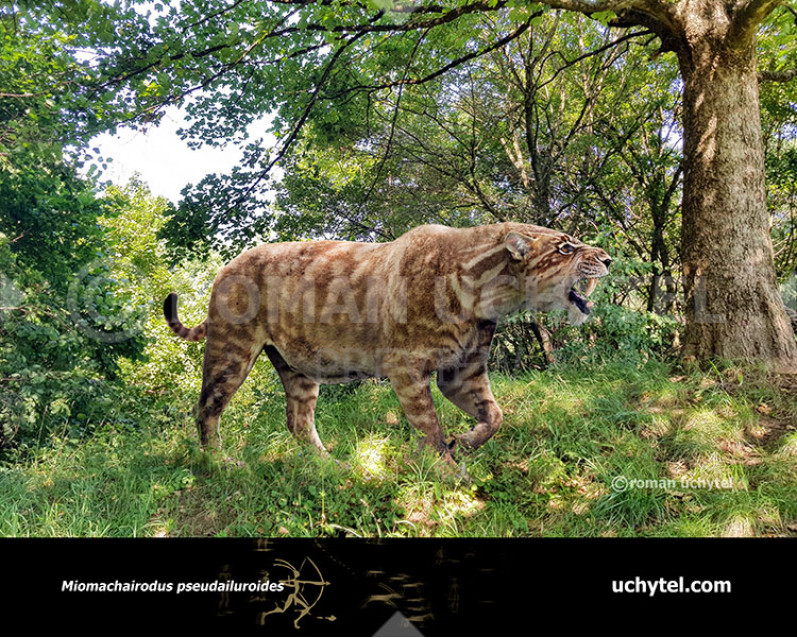
202151202151Miomachairodus (Miomachairodus pseudailuroides (Schmidt-Kittler, 1976))
Order: Carnivore.
Family: Felidae
Subfamily: Machairodontinae
Tribe: †Machairodontini
Size: 1,6 m in length, 80 cm in height, 100+ kg of weight.
Time period: Middle Miocene–Late Miocene (Eurasia)
Miomachairodus is an extinct genus of large saber-toothed cats containing only a single species, Miomachairodus pseudailuroides. It is mainly known from Middle Miocene-age fossils in Turkey and persisted until the early Late Miocene. The genus was first named by paleontologist Norbert Schmidt-Kittler in 1976 based on the holotype, a partial skull from Akçaköy, Eşme District, Turkey, and a second specimen, a lower jaw from Yeni Eskihisar. Fossils of this machairodont have been found in the Vallesian-age Bahe Formation in Shaanxi, China, and Yeni Eskihisar in Anatolia. The generic name Miomachairodus is a combination of Mio, referring to the Miocene when it lived, and Machairodus; the specific name pseudailuroides means "like Pseudaelurus".
In 2022, material from the Guanigou fauna in the Linxia Basin was described as Miomachairodus sp., and the authors suggested that it represented a new species of Miomachairodus. The fossil, a partial maxilla from the early Late Miocene, represented the oldest known machairodontine in Asia.
Miomachairodus (Miomachairodus pseudailuroides (Schmidt-Kittler, 1976))
Order: Carnivore.
Family: Felidae
Subfamily: Machairodontinae
Tribe: †Machairodontini
Size: 1,6 m in length, 80 cm in height, 100+ kg of weight.
Time period: Middle Miocene–Late Miocene (Eurasia)
Miomachairodus is an extinct genus of large saber-toothed cats containing only a single species, Miomachairodus pseudailuroides. It is mainly known from Middle Miocene-age fossils in Turkey and persisted until the early Late Miocene. The genus was first named by paleontologist Norbert Schmidt-Kittler in 1976 based on the holotype, a partial skull from Akçaköy, Eşme District, Turkey, and a second specimen, a lower jaw from Yeni Eskihisar. Fossils of this machairodont have been found in the Vallesian-age Bahe Formation in Shaanxi, China, and Yeni Eskihisar in Anatolia. The generic name Miomachairodus is a combination of Mio, referring to the Miocene when it lived, and Machairodus; the specific name pseudailuroides means "like Pseudaelurus".
In 2022, material from the Guanigou fauna in the Linxia Basin was described as Miomachairodus sp., and the authors suggested that it represented a new species of Miomachairodus. The fossil, a partial maxilla from the early Late Miocene, represented the oldest known machairodontine in Asia.
-346x277.jpg "Machairodus aphanistus")
-346x277.jpg "Machairodus (Neomachairodus) copei")