-797x638.jpg "Hesperornis")
-797x638.jpg "Hesperornis")
1-797x638.jpg "Hesperornis")
Hesperornis
202143202143Hesperornis (†Hesperornis (Marsh, 1872))
Synonym: Lestornis, Coniornis, Hargeria
Class: Reptilia
Clade: Avialae
Family: †Hesperornithidae
Dimensions: 1.5–2 meters long, weight - 10.6 kg
Temporal range: Late Cretaceous, 95–83.5 Ma
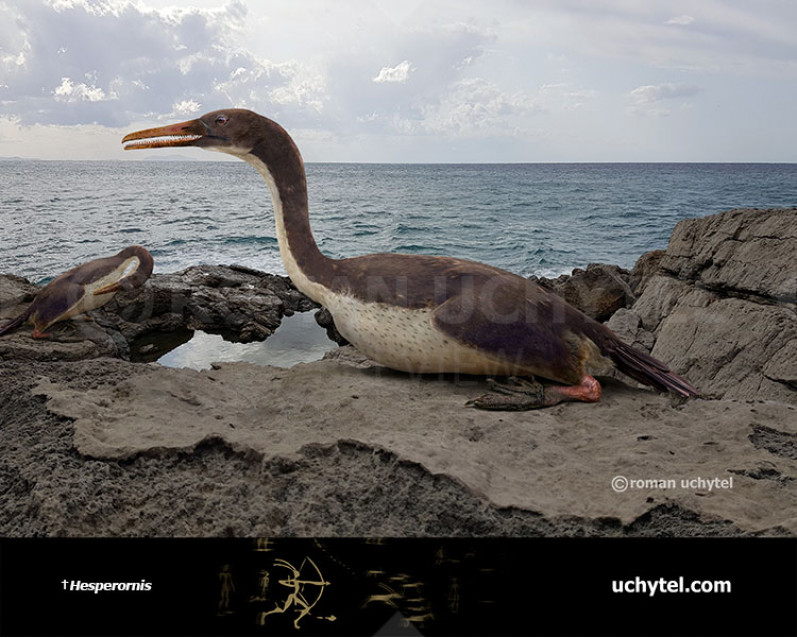
Hesperornis is a extinct genus of cormorant-like birds, measuring about 1.5–2 metres long and weighing around 10.6 kilograms.. Locations for Hesperornis fossils include the Late Cretaceous marine limestones from Kansas and the marine shales from Canada. Nine species are recognised, eight of which have been recovered from rocks in North America and one from Russia.
It had virtually no wings, and swam with its powerful hind legs. Studies on the feet initially indicated that Hesperornis and kin had lobed toes similar to modern-day grebes, as opposed to webbed toes as seen in most aquatic birds such as loons. More recent work looking at the morphometrics of the feet in hesperornithiformes and modern sea birds has thrown this interpretation into question, making webbed toes equally as likely as lobed toes for this group.
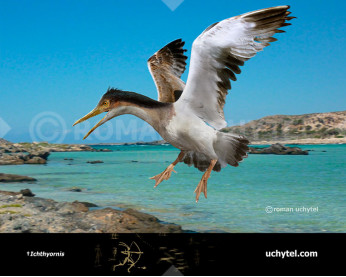
Like many other Mesozoic birds such as Ichthyornis, Hesperornis had teeth as well as a beak. In the hesperornithiform lineage they were of a different arrangement than in any other known bird (or in non-avian theropod dinosaurs), with the teeth sitting in a longitudinal groove rather than in individual sockets, in a notable case of convergent evolution with mosasaurs. Studies of the bone surface show that at least the tips of the jaws supported a hard, keratinous beak similar to that found in modern birds. The palate (mouth roof) contained small pits that allowed the lower teeth to lock into place when the jaws were closed. They also retained a primitive-like joint between the lower jaw bones. It is believed that this allowed them to rotate the back portion of the mandible independently of the front, thus allowing the lower teeth to disengage.
Hesperornis was primarily marine, and lived in the waters of such contemporary shallow shelf seas as the Western Interior Seaway, the Turgai Strait, and the North Sea, which then were subtropical to tropical waters, much warmer than today. However, some of the youngest known specimens of Hesperornis have been found in inland freshwater deposits of the Foremost Formation, suggesting that some species of Hesperornis may have eventually moved, at least partially, away from a primarily marine habitat. Additionally, the species H. altus comes from the freshwater deposits at the base of the Judith River Formation.
Like modern loons, Hesperornis were probably excellent foot-propelled divers, but might have been ungainly on land. They likely moved on land by pushing themselves along on their bellies, like modern seals. However, more recent studies on hesperornithean hindlimbs suggest they were more functionally similar to those of the still upright walking cormorants.

-70x56.jpg "2")
-70x56.jpg "3")
1-70x56.jpg "4")
Hesperornis (†Hesperornis (Marsh, 1872))
Synonym: Lestornis, Coniornis, Hargeria
Class: Reptilia
Clade: Avialae
Family: †Hesperornithidae
Dimensions: 1.5–2 meters long, weight - 10.6 kg
Temporal range: Late Cretaceous, 95–83.5 Ma
Hesperornis is a extinct genus of cormorant-like birds, measuring about 1.5–2 metres long and weighing around 10.6 kilograms.. Locations for Hesperornis fossils include the Late Cretaceous marine limestones from Kansas and the marine shales from Canada. Nine species are recognised, eight of which have been recovered from rocks in North America and one from Russia.
It had virtually no wings, and swam with its powerful hind legs. Studies on the feet initially indicated that Hesperornis and kin had lobed toes similar to modern-day grebes, as opposed to webbed toes as seen in most aquatic birds such as loons. More recent work looking at the morphometrics of the feet in hesperornithiformes and modern sea birds has thrown this interpretation into question, making webbed toes equally as likely as lobed toes for this group.
Like many other Mesozoic birds such as Ichthyornis, Hesperornis had teeth as well as a beak. In the hesperornithiform lineage they were of a different arrangement than in any other known bird (or in non-avian theropod dinosaurs), with the teeth sitting in a longitudinal groove rather than in individual sockets, in a notable case of convergent evolution with mosasaurs. Studies of the bone surface show that at least the tips of the jaws supported a hard, keratinous beak similar to that found in modern birds. The palate (mouth roof) contained small pits that allowed the lower teeth to lock into place when the jaws were closed. They also retained a primitive-like joint between the lower jaw bones. It is believed that this allowed them to rotate the back portion of the mandible independently of the front, thus allowing the lower teeth to disengage.
Hesperornis was primarily marine, and lived in the waters of such contemporary shallow shelf seas as the Western Interior Seaway, the Turgai Strait, and the North Sea, which then were subtropical to tropical waters, much warmer than today. However, some of the youngest known specimens of Hesperornis have been found in inland freshwater deposits of the Foremost Formation, suggesting that some species of Hesperornis may have eventually moved, at least partially, away from a primarily marine habitat. Additionally, the species H. altus comes from the freshwater deposits at the base of the Judith River Formation.
Like modern loons, Hesperornis were probably excellent foot-propelled divers, but might have been ungainly on land. They likely moved on land by pushing themselves along on their bellies, like modern seals. However, more recent studies on hesperornithean hindlimbs suggest they were more functionally similar to those of the still upright walking cormorants.