-797x638.jpg "Ichthyornis")
Ichthyornis
202144202144Ichthyornis (†Ichthyornis (Marsh, 1873))
Clade: Avialae
Clade: Ornithurae
Clade: †Ichthyornithes
Temporal range: the Late Cretaceous period of North America (95–83.5 million years ago)
Dimensions: length - 25-45 сm, weight - 300 - 1000 g
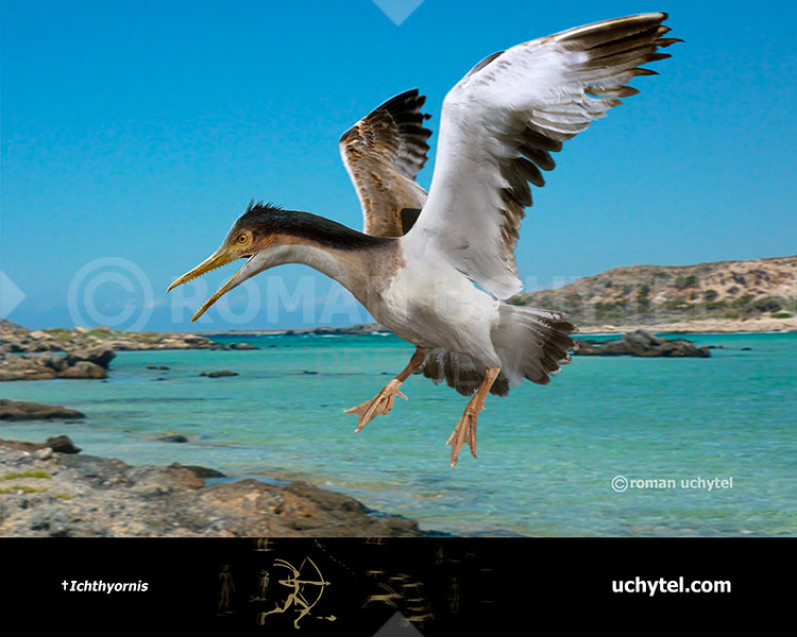
Ichthyornis is an extinct genus of toothy seabird-like ornithuran from the late Cretaceous period of North America. It was the first known prehistoric bird relative preserved with teeth, and Charles Darwin noted its significance during the early years of the theory of evolution. Its fossil remains are known from the chalks of Alberta, Alabama, Kansas (Greenhorn Limestone), New Mexico, Saskatchewan, and Texas, in strata that were laid down in the Western Interior Seaway during the Turonian through Campanian ages, about 95–83.5 million years ago. Ichthyornis is a common component of the Niobrara Formation fauna, and numerous specimens have been found.
Ichthyornis has been historically important in shedding light on bird evolution. It was remains important today as it is one of the few Mesozoic era ornithurans known from more than a few specimens.
It is thought that Ichthyornis was the Cretaceous ecological equivalent of modern seabirds such as gulls, petrels, and skimmers. An average specimen was the size of a pigeon, 24 centimetres long, with a skeletal wingspan (not taking feathers into account) of around 43 centimetres, though there is considerable size variation among known specimens, with some smaller and some much larger than the type specimen of I. dispar.
Ichthyornis is notable primarily for its combination of vertebrae which are concave both in front and back (similar to some fish, which is where it gets its name) and several more subtle features of its skeleton which set it apart from its close relatives. Ichthyornis is perhaps most well known for its teeth. The teeth were present only in the middle portion of the upper and lower jaws. The jaw tips had no teeth and were covered in a beak. The beak of Ichthyornis, like the hesperornithids, was compound and made up of several distinct plates, similar to the beak of an albatross, rather than a single sheet of keratin as in most modern birds. The teeth were more flattened than the rounded teeth found in crocodilians, though they became wider towards the base of the crown. The tips of the teeth were curved backward and lacked any serrations. They were arranged in a groove, much like those of marine reptiles.
The wings and breastbone were very modern in appearance, suggesting strong flight ability and placing it with modern birds in the advanced group Carinatae. Unlike earlier avialans such as the enantiornithines, the species appears to have matured to adulthood in a rather short, continuous process.
A study on an Ichthyornis endocast reveals that it had a relatively

-70x56.jpg "2")
Ichthyornis (†Ichthyornis (Marsh, 1873))
Clade: Avialae
Clade: Ornithurae
Clade: †Ichthyornithes
Temporal range: the Late Cretaceous period of North America (95–83.5 million years ago)
Dimensions: length - 25-45 сm, weight - 300 - 1000 g
Ichthyornis is an extinct genus of toothy seabird-like ornithuran from the late Cretaceous period of North America. It was the first known prehistoric bird relative preserved with teeth, and Charles Darwin noted its significance during the early years of the theory of evolution. Its fossil remains are known from the chalks of Alberta, Alabama, Kansas (Greenhorn Limestone), New Mexico, Saskatchewan, and Texas, in strata that were laid down in the Western Interior Seaway during the Turonian through Campanian ages, about 95–83.5 million years ago. Ichthyornis is a common component of the Niobrara Formation fauna, and numerous specimens have been found.
Ichthyornis has been historically important in shedding light on bird evolution. It was remains important today as it is one of the few Mesozoic era ornithurans known from more than a few specimens.
It is thought that Ichthyornis was the Cretaceous ecological equivalent of modern seabirds such as gulls, petrels, and skimmers. An average specimen was the size of a pigeon, 24 centimetres long, with a skeletal wingspan (not taking feathers into account) of around 43 centimetres, though there is considerable size variation among known specimens, with some smaller and some much larger than the type specimen of I. dispar.
Ichthyornis is notable primarily for its combination of vertebrae which are concave both in front and back (similar to some fish, which is where it gets its name) and several more subtle features of its skeleton which set it apart from its close relatives. Ichthyornis is perhaps most well known for its teeth. The teeth were present only in the middle portion of the upper and lower jaws. The jaw tips had no teeth and were covered in a beak. The beak of Ichthyornis, like the hesperornithids, was compound and made up of several distinct plates, similar to the beak of an albatross, rather than a single sheet of keratin as in most modern birds. The teeth were more flattened than the rounded teeth found in crocodilians, though they became wider towards the base of the crown. The tips of the teeth were curved backward and lacked any serrations. They were arranged in a groove, much like those of marine reptiles.
The wings and breastbone were very modern in appearance, suggesting strong flight ability and placing it with modern birds in the advanced group Carinatae. Unlike earlier avialans such as the enantiornithines, the species appears to have matured to adulthood in a rather short, continuous process.
A study on an Ichthyornis endocast reveals that it had a relatively