-797x638.jpg "The tigre dantero")
-797x638.jpg "The tigre dantero")
The tigre dantero
202160202160The tigre dantero (Spanish: "tapir-eating tiger") is a cryptid cat reported from the cloud forests of Venezuela, Colombia, Ecuador, and Peru, described as a long-fanged cat the same size as, a jaguar.
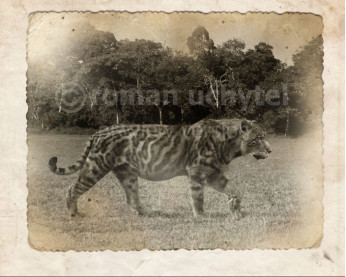
These unknown cats are described as striped animals with two very large protruding teeth, and are said to be somewhat smaller than a jaguar: the "mutant jaguar" specimen was allegedly 73 kg with long fangs. A 1991 sighting from Venezuela described a jaguar-sized animal with light brown fur, a short tail, large fangs, and powerful, well-built forelimbs. In Venezuela, they are said to prey on tapirs, and they are always reputed to be very shy and rare animals, reported from deep montane and highland rainforests, most prominently Canaima National Park, which contains Auyán-tepui and the forests surrounding it.
Gustavo Sánchez Romero received descriptions of the tigre dantero when he visited Canaima National Park, which he subsequently communicated to Karl Shuker. During Bill Gibbons 2017 expedition to Peru, a man named David Angel, a resident of the Madre de Dios region of central Peru, claimed that a large, sabre-toothed cat was known to exist in central forests and in the cloud forests of the north.
It is also sometimes referred to as the wairarima, a name which can also apply to a different cryptid felid.
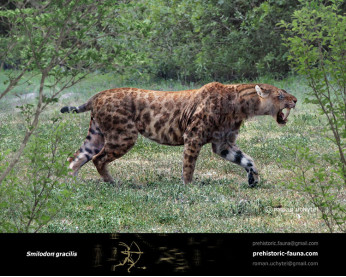
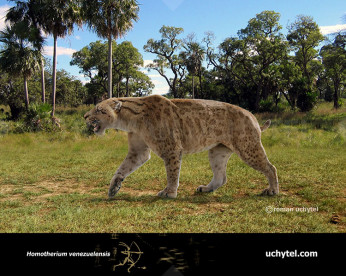
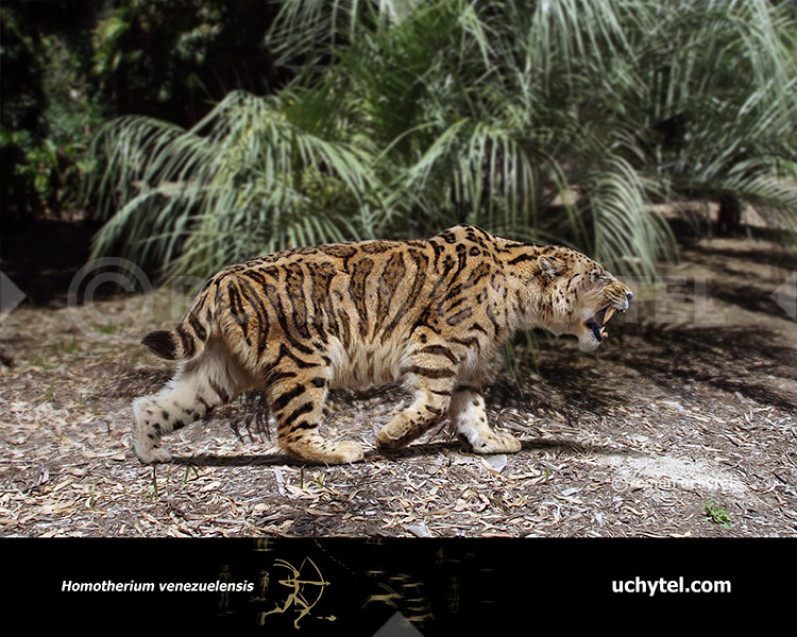
Eyewitness Tirson Sosa directly identified the animal he saw in 1991 with a picture of Smilodon which he was shown. Karl Shuker notes that, given the apparent extinction or extirpation of most of South America's large herbivorous animals, it is unlikely that a full-sized Smilodon populator could survive there in the present day; however, he suggests that a smaller form would have a better chance of carving out a niche for itself, "especially in relatively inaccessible, undisturbed areas, such as remote, mountainous cloud forests," where a striped coat would provide it with effective camouflage. One species, Smilodon gracilis, was smaller. Another way for a sabre-toothed cat to find a niche for itself in modern South America would be to become a semi-aquatic animal, and indeed, such cryptids are reported from the length and breadth of the continent. If the animals are sabre-toothed cats, they are likely to be descendants of either the famous Smilodon, which ranged across much of South America, or the smaller, shorter-fanged South American scimitar-toothed cat (Homotherium venezuelensis), which made it at least as far south as Venezuela, and possibly Uruguay.
-70x56.jpg "1")

-70x56.jpg "3")
The tigre dantero (Spanish: "tapir-eating tiger") is a cryptid cat reported from the cloud forests of Venezuela, Colombia, Ecuador, and Peru, described as a long-fanged cat the same size as, a jaguar.
These unknown cats are described as striped animals with two very large protruding teeth, and are said to be somewhat smaller than a jaguar: the "mutant jaguar" specimen was allegedly 73 kg with long fangs. A 1991 sighting from Venezuela described a jaguar-sized animal with light brown fur, a short tail, large fangs, and powerful, well-built forelimbs. In Venezuela, they are said to prey on tapirs, and they are always reputed to be very shy and rare animals, reported from deep montane and highland rainforests, most prominently Canaima National Park, which contains Auyán-tepui and the forests surrounding it.
Gustavo Sánchez Romero received descriptions of the tigre dantero when he visited Canaima National Park, which he subsequently communicated to Karl Shuker. During Bill Gibbons 2017 expedition to Peru, a man named David Angel, a resident of the Madre de Dios region of central Peru, claimed that a large, sabre-toothed cat was known to exist in central forests and in the cloud forests of the north.
It is also sometimes referred to as the wairarima, a name which can also apply to a different cryptid felid.
Eyewitness Tirson Sosa directly identified the animal he saw in 1991 with a picture of Smilodon which he was shown. Karl Shuker notes that, given the apparent extinction or extirpation of most of South America's large herbivorous animals, it is unlikely that a full-sized Smilodon populator could survive there in the present day; however, he suggests that a smaller form would have a better chance of carving out a niche for itself, "especially in relatively inaccessible, undisturbed areas, such as remote, mountainous cloud forests," where a striped coat would provide it with effective camouflage. One species, Smilodon gracilis, was smaller. Another way for a sabre-toothed cat to find a niche for itself in modern South America would be to become a semi-aquatic animal, and indeed, such cryptids are reported from the length and breadth of the continent. If the animals are sabre-toothed cats, they are likely to be descendants of either the famous Smilodon, which ranged across much of South America, or the smaller, shorter-fanged South American scimitar-toothed cat (Homotherium venezuelensis), which made it at least as far south as Venezuela, and possibly Uruguay.