-797x638.jpg "Parabos")
Parabos
202157202157Parabos (Parabos (Arambourg and Piveteau, 1929))
Order: Artiodactyla
Family: Bovidae
Dimensions: length - 2.4 m, height - 145 сm, weight - 180-340 kg
Temporal range: during the late Miocene to the early Pleistocene (8.7–2.588 million years ago, Europe)
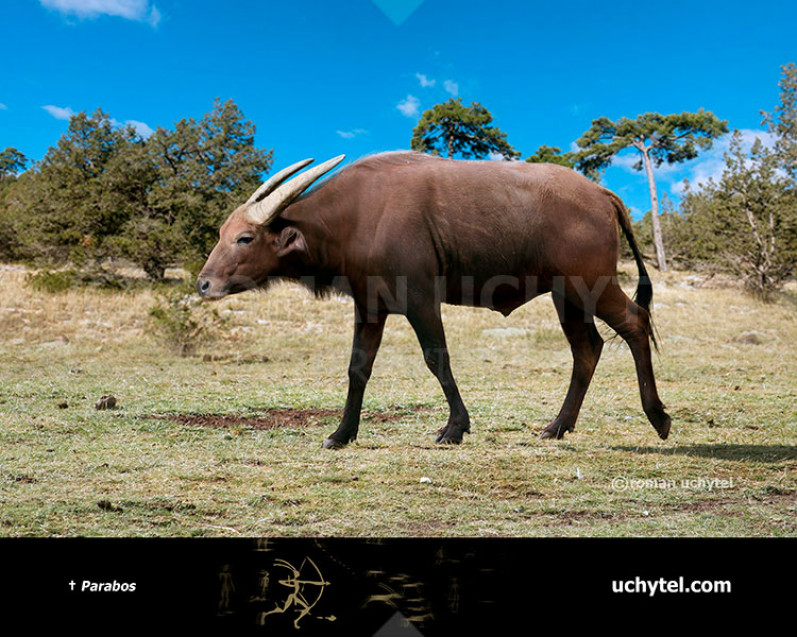
Parabos is a genus of extinct mammals in the family Bovidae. They lived from the late Miocene to the early Pleistocene (8.7–2.588 million years ago) in Europe (fossil remains have been found in Spain, Italy, Romania, Greece, Moldova, and Hungary). In appearance, these animals vaguely resembled the wildebeest. Their legs were slender, strong, and elongated, but their bodies were quite massive, and their heads bore two large, straight horns pointing backward and growing from the back of the eye sockets. Parabos is considered the first bovine to have premolars and molars with high crowns (hypsodont), indicating an adaptation to feeding on tough plants, such as grass. The size of Parabos varied from species to species: some, such as P. cordieri, were quite small, about the size of a modern oryx, while others (such as P. boodon) were larger than a wildebeest.
The genus Parabos was established in 1929 by Arambourg and Piveteau to include the species Antilope cordieri, a medium-sized antelope typical of the European Pliocene. Subsequently, other species, such as P. macedoniae, P. soriae, and P. athanasiui, were also assigned to the genus Parabos. The large species P. boodon is sometimes assigned to the related genus Alephis.
Parabos is considered the oldest and most basal member of the Bovinae subfamily, to which most large bovids belong. The oldest specimens date from the Late Miocene of Spain and Italy.

-70x56.jpg "2")
Parabos (Parabos (Arambourg and Piveteau, 1929))
Order: Artiodactyla
Family: Bovidae
Dimensions: length - 2.4 m, height - 145 сm, weight - 180-340 kg
Temporal range: during the late Miocene to the early Pleistocene (8.7–2.588 million years ago, Europe)
Parabos is a genus of extinct mammals in the family Bovidae. They lived from the late Miocene to the early Pleistocene (8.7–2.588 million years ago) in Europe (fossil remains have been found in Spain, Italy, Romania, Greece, Moldova, and Hungary). In appearance, these animals vaguely resembled the wildebeest. Their legs were slender, strong, and elongated, but their bodies were quite massive, and their heads bore two large, straight horns pointing backward and growing from the back of the eye sockets. Parabos is considered the first bovine to have premolars and molars with high crowns (hypsodont), indicating an adaptation to feeding on tough plants, such as grass. The size of Parabos varied from species to species: some, such as P. cordieri, were quite small, about the size of a modern oryx, while others (such as P. boodon) were larger than a wildebeest.
The genus Parabos was established in 1929 by Arambourg and Piveteau to include the species Antilope cordieri, a medium-sized antelope typical of the European Pliocene. Subsequently, other species, such as P. macedoniae, P. soriae, and P. athanasiui, were also assigned to the genus Parabos. The large species P. boodon is sometimes assigned to the related genus Alephis.
Parabos is considered the oldest and most basal member of the Bovinae subfamily, to which most large bovids belong. The oldest specimens date from the Late Miocene of Spain and Italy.