-797x638.jpg "Rhinotitan")
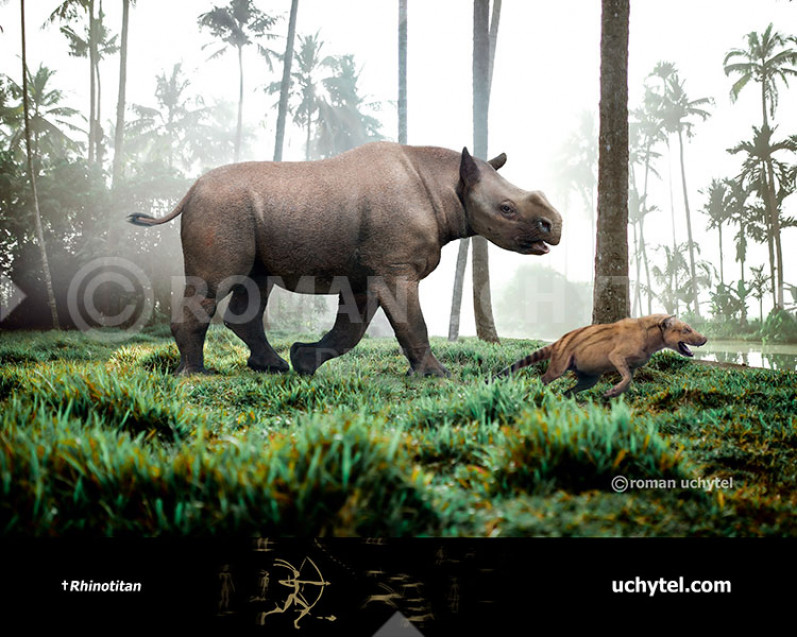
Rhinotitan
202197202197Rhinotitan (†Rhinotitan (Granger and Gregory, 1943))
Order: Perissodactyla
Family: Brontotheriidae
Temporal range: during the Middle Eocene (Asia)
Dimensions: length - 2,9 m, height - 160-180 сm, weight - 1,686 - 2,027 kg
A typical representative: †Rhinotitan kaiseni
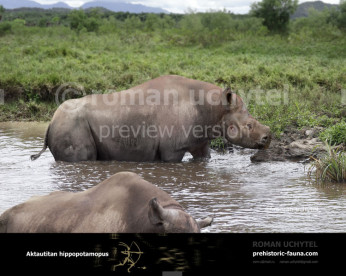
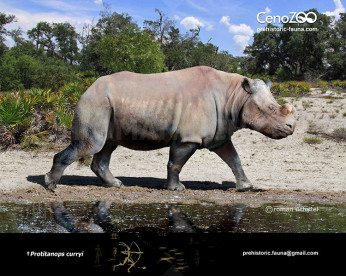
Rhinotitan is a genus of extinct mammals in the family Brontotheriidae of the order Perissodactyla that lived during the Middle Eocene in East Asia (China). It had small horns, placed high above the orbits (eye sockets) up on the nasal process. The horns projected nearly horizontally out towards the side. Different researchers identify between 1 and 3 species of Rhinotitan. It was has been estimated to have reached a body mass of 1,686 - 2,027 kilograms.
Protitanotherium mongoliensis (Osborn, 1923) is the first brontothere described based on specimens collected by the American Museum of Natural History’s Central Asian Expedition. Two years later, Osborn described two more species from the Gobi—Protitanotherium andrewsi and Dolichorhinus kaiseni. V. Granger and V. Gregory (1943) combined these three species into a new genus, Rhinotitan. The fact that all these species are of the same age and were found at the same site raises some doubts about the validity of their separation, but many paleontologists consider it justified. The differences between these species may well turn out to be variation within a single species. Some researchers (Takai, 1939) consider R. andrewsi and R. mongoliensis to be the same species but of different sexes and declare them synonyms (Wang, 1982). Michlbachler recognizes only two species—R. andrewsi and R. kaiseni—and considers R. mongoliensis a nomen dubium.

-70x56.jpg "2")
Rhinotitan (†Rhinotitan (Granger and Gregory, 1943))
Order: Perissodactyla
Family: Brontotheriidae
Temporal range: during the Middle Eocene (Asia)
Dimensions: length - 2,9 m, height - 160-180 сm, weight - 1,686 - 2,027 kg
A typical representative: †Rhinotitan kaiseni
Rhinotitan is a genus of extinct mammals in the family Brontotheriidae of the order Perissodactyla that lived during the Middle Eocene in East Asia (China). It had small horns, placed high above the orbits (eye sockets) up on the nasal process. The horns projected nearly horizontally out towards the side. Different researchers identify between 1 and 3 species of Rhinotitan. It was has been estimated to have reached a body mass of 1,686 - 2,027 kilograms.
Protitanotherium mongoliensis (Osborn, 1923) is the first brontothere described based on specimens collected by the American Museum of Natural History’s Central Asian Expedition. Two years later, Osborn described two more species from the Gobi—Protitanotherium andrewsi and Dolichorhinus kaiseni. V. Granger and V. Gregory (1943) combined these three species into a new genus, Rhinotitan. The fact that all these species are of the same age and were found at the same site raises some doubts about the validity of their separation, but many paleontologists consider it justified. The differences between these species may well turn out to be variation within a single species. Some researchers (Takai, 1939) consider R. andrewsi and R. mongoliensis to be the same species but of different sexes and declare them synonyms (Wang, 1982). Michlbachler recognizes only two species—R. andrewsi and R. kaiseni—and considers R. mongoliensis a nomen dubium.